
Choose a Roulette Game by Its Rules, Not Its Promise
 Available in US
Understand how table positions define bets, why wheel rules affect costs, and what betting systems can—and cannot—change.
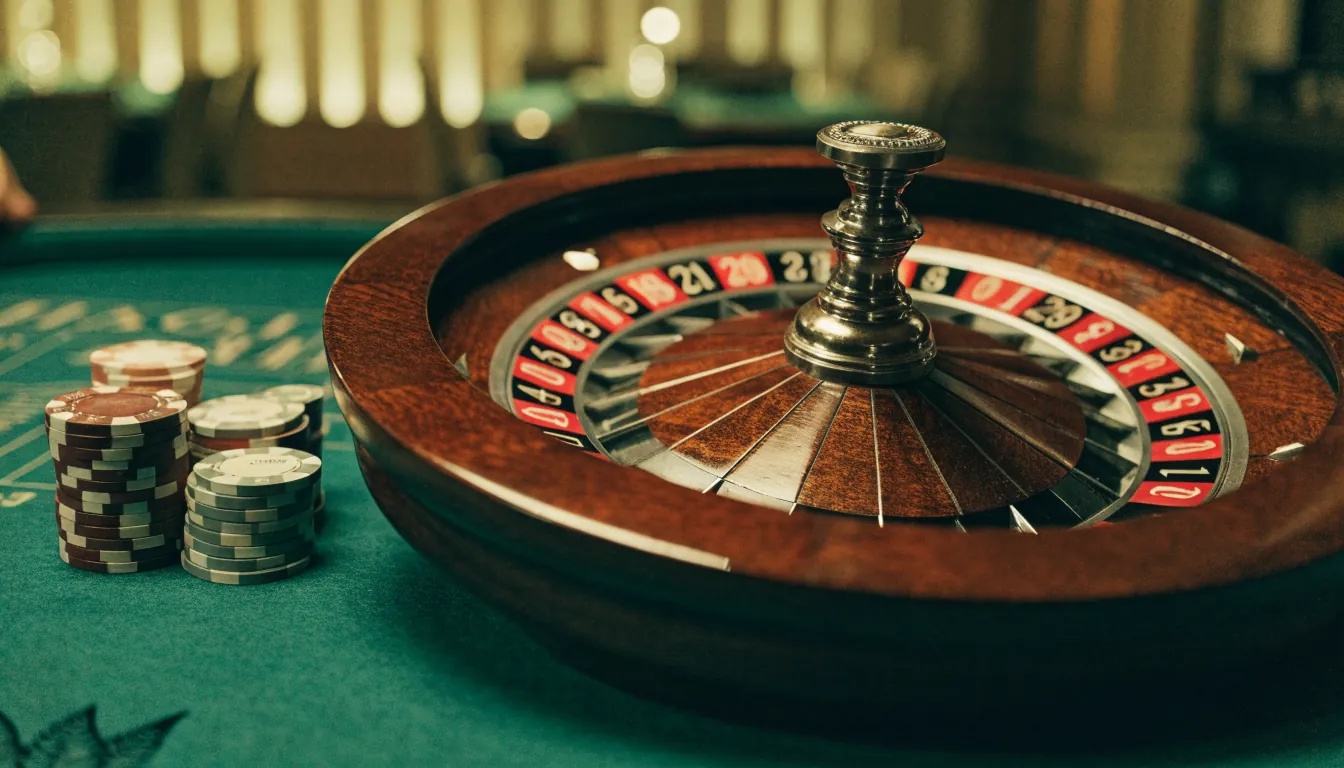
How Roulette Bets Work Across the Table and Wheel
A roulette table can make the game look more complicated than it is. The layout separates bets by where they are placed, but the basic distinction is simple: some bets name a particular number or a small group of numbers, while others cover a broader category. The placement shows the selection; it does not change what that selection means.
I learned to read the layout from the inside out. Start with the numbered grid, then look at the spaces and lines around it. A chip placed inside a number square selects that number. A chip on a line between squares selects the numbers sharing that boundary. A chip at the meeting point of several squares covers the numbers around that point. These are all inside bets: they target a narrower part of the layout rather than a broad category.
The outside betting area sits around the grid. Its options include red or black, odd or even, and low or high numbers. Other outside bets cover columns or sections of the numbered grid. These are broader selections, but broad does not mean safer in every sense, nor does it make a result predictable. It simply means that the bet applies to a larger defined group.
Choosing roulette online in New Zealand is easier when you can check the available operator details before deciding where to play. This guide offers a concise reference to help you assess the options.
-
7Bit Casino
- License
- Tobique Gaming Commission, licence no. 0000091
7Bit Casino lists a licence from the Tobique Gaming Commission, licence no. 0000091.
-
N1 Casino
- License
- Malta Gaming Authority, licence no. MGA/B2C/394/2017
N1 Casino lists a Malta Gaming Authority licence, no. MGA/B2C/394/2017.
-
Lamabet
- Payout speed
- 1-3 business days
Lamabet has a stated payout speed of 1–3 business days.
-
Zotabet
- License
- 07017519840
- Payout speed
- 1-3 business days
Zotabet lists licence no. 07017519840 and a payout speed of 1–3 business days.
-
Play Grand
- License
- Malta Gaming Authority, licence no. MGA/B2C/370/2017
Play Grand lists a Malta Gaming Authority licence, no. MGA/B2C/370/2017.
-
Ricky Casino
- License
- Tobique Gaming Commission, licence no. 0000002
Ricky Casino lists a licence from the Tobique Gaming Commission, licence no. 0000002.
-
BitStarz
- License
- Curaçao Gaming Authority, licence no. OGL/2024/165/0185
BitStarz lists a Curaçao Gaming Authority licence, no. OGL/2024/165/0185.
-
Neospin
- License
- Tobique Gaming Commission, licence no. 0000064
Neospin lists a licence from the Tobique Gaming Commission, licence no. 0000064.
-
Wintino
- Payout speed
- 1-3 business days
Wintino has a stated payout speed of 1–3 business days.
The table is a map of betting selections. It is not a map of the wheel.
That distinction matters when a dealer or game menu offers called bets. These are named groups of numbers associated with the wheel’s arrangement. The group is defined by where its numbers sit around the rim, not by how those numbers happen to appear in the table grid. A called bet may therefore cross several rows or columns on the table while forming a connected section of the wheel.
This is where players can misread the display. The grid encourages a row-and-column way of thinking, because it is designed to make ordinary inside and outside selections easy to place. Called bets use a different organising principle. Their chips may be spread across several table positions to represent a single wheel-based selection. The name refers to the group, not to a neat block on the felt.
On a digital table, the same distinction applies even if a menu places called bets in a tidy list. The interface is translating a wheel-based group into chip positions. It is worth checking which numbers are included before confirming the bet, rather than assuming the label means a row, column or adjacent patch on the grid. A clear interface should show the selection; the label alone is not a substitute for understanding it.

Inside bets and outside bets
Inside bets are specific. A straight-up selection covers one number. A split covers two neighbouring numbers on the table layout. A street covers a row of three; a corner covers a square of four; and a line bet covers two adjacent rows. The exact placement determines the selection. These bets are often described as more adventurous because they focus on a smaller group, but that description is about the shape of the bet, not a promise about what will happen.
Outside bets are easier to scan at a glance. Colour, parity, low or high ranges, and columns give the player broader categories to choose from. The table marks where each category is placed, so a chip does not need to sit on a particular number square. Still, a broad category is not a forecast. Roulette does not respond to the appearance of a chip or to the apparent neatness of a selection.
The question of the “best” roulette bet usually mixes up two different things: how much of the layout a bet covers and what the player wants from a session. A narrow bet is not a cleverer bet merely because it is precise. A broad bet is not automatically a better choice merely because its category looks familiar. The mechanics tell what a selection covers; they do not identify a bet that can reliably win.
That is the practical foundation for choosing among bet types. First identify the selection, then check how the table represents it. For an ordinary grid bet, read the squares and boundaries. For an outside bet, read the printed category. For a called bet, follow the listed wheel group rather than trying to infer it from the table’s rows.
- Identify if the selection is an inside bet, outside bet, or called bet
- Read the squares and boundaries for grid bets
- Read the printed category for outside bets
- Follow the listed wheel group for called bets
- Confirm the covered area before the spin begins
Reading the layout before placing chips
When I checked tables, the avoidable mistakes were usually not exotic. A player saw a chip near a line and assumed it covered the same numbers as a neighbouring placement, or treated a wheel-based call as if it were a table row. The layout gives precise boundaries, but those boundaries differ by bet type. Placement matters.
A useful habit is to pause over the selected area and confirm what it covers before the spin begins. This is not a way to improve the result; it is a way to make sure the bet matches the intended selection. The table can be busy, and a misplaced chip is still a real bet once accepted. Small check. Then the spin.
The best way to play roulette is not hidden in a special shape of chip placement. It begins with knowing whether a bet names one number, a local group on the grid, a broad outside category, or a group traced around the wheel. Once that is clear, the table becomes easier to read—and the difference between a table position and a wheel position stops being a trap.
Choosing an Online Casino in New Zealand: Read the Conditions, Not the Slogan
A roulette page can look straightforward while the conditions attached to its welcome offer are not. I learned to read the promotion and the withdrawal rules as one document: the headline describes what is offered, while the terms explain who qualifies, which games count, when the offer expires and what happens if a withdrawal is requested. “Bonus” is a label, not cash available to withdraw.

That distinction matters when comparing online roulette access. A site may display roulette in its lobby but apply separate eligibility or promotional conditions to particular games. Before treating an offer as relevant, check whether roulette contributes towards wagering requirements and whether any restrictions apply to the bonus balance. A game’s presence does not establish that its play counts in the way the promotion requires.
Read the offer as a set of conditions
The required wagering is substantial: bonus money must be wagered 50 times within 30 days. Winnings from free spins must be wagered 50 times within 7 days. These are separate requirements, so a free-spin promotion can carry its own deadline even when another bonus is active. The expiry period and the game contribution rules determine how practical those conditions are; the headline value does not.
A withdrawal request voids all active or pending bonuses. That can change the balance being considered for withdrawal, so the rule deserves attention before accepting an offer, not after a request has been made. I have seen the promotional wording do its job perfectly: it draws the eye to the reward, while the operative terms sit elsewhere. Read both.
Other details can affect eligibility. Operators may set conditions for who can claim a bonus, specify an expiry, define how different games contribute to wagering, and restrict withdrawals. Those terms are not decorative. They determine whether the offer fits the intended play and what actions may cancel it. If a condition is unclear, treating the bonus as guaranteed withdrawable value is a poor assumption.
The same discipline applies to “free” play. A free roulette game may be useful for learning an interface, but it does not establish that a real-money promotion has the same rules or that its winnings are withdrawable without conditions. Separate demonstration play, bonus credit and cash balance in the mind. They are different things.
Understand the New Zealand transition
New Zealand’s framework changed with the Online Casino Gambling Act 2026, which came into force on 1 May 2026. The Act created the country’s first domestic licensing regime for online casino gambling. The Gambling Act 2003 does not permit online casinos to be based in New Zealand, so the new framework does not mean that domestic online casinos are already operating under an established local system.
The transition is limited. Providers that were already serving people in New Zealand before 1 May 2026 may continue until 1 December 2026 under the transitional provisions. The full licensed regime is not expected to be operational until 2027. Providers that have not applied for a licence must cease conducting online casino gambling in New Zealand by 1 December 2026; unlicensed operation is expected to become an offence around mid-2027.
The Department of Internal Affairs is the primary gambling regulator and oversees the online casino licensing framework. The Gambling Commission hears and determines casino licensing applications, issues online casino licences and approves changes to licence conditions. Those roles are distinct. A site’s own use of licensing language is not a substitute for understanding which regulator has authority and what stage the framework has reached.

Before the Act, offshore online casino gambling was not licensed or supervised by a New Zealand regulator, and customers wagering with offshore sites had no domestic government recourse. The transitional arrangement does not erase that history or make every promotional claim a regulatory assurance. Nor does it mean a player should assume that a provider has a New Zealand licence simply because it accepts New Zealand customers.
Compare access without mistaking it for protection
For a roulette choice, separate three questions: whether the game is accessible, what the promotion requires, and what regulatory status applies during the transition. An app or casino lobby answers only the first. It says nothing by itself about bonus eligibility, withdrawal restrictions or the provider’s position under the changing licensing framework.
“Best” is not a useful shortcut when the terms differ. I would compare the written conditions rather than the size of a headline offer: eligible games, wagering rules, expiry, contribution and the effect of a withdrawal request. If the terms make those points hard to establish, the promotion is hard to evaluate. That is the practical answer.
Why the Wheel Matters More Than the Bet’s Payout
A roulette payout can look attractive in isolation, but it does not tell the whole story. The wheel determines how many outcomes compete for that payout, and that changes the chance of a winning result. When comparing the best odds at roulette, the first distinction is not a clever wager: it is whether the wheel has one zero or two.
European Roulette
Features 37 pockets (one zero) with a house edge of 2.70% and a payout percentage of 97.30%.
American Roulette
Features 38 pockets (double zero) with a house edge of 5.26% and a payout percentage of 94.70%.
European Roulette has 37 pockets: one zero and the numbered pockets. Its house edge is 2.70%. American Roulette has 38 pockets, because it adds a double zero alongside the single zero, and its house edge is 5.26%. The payouts printed on the table may look familiar across both versions, but the extra pocket changes the mathematics underneath them.
The house edge describes the casino’s mathematical advantage over time, expressed as a proportion of stakes wagered. It is not a prediction of what will happen in a particular session. A player can win on either wheel, and a run of results can go against the usual expectation. The difference is structural: with the American wheel, the same wager faces an additional losing outcome, while the ordinary payout does not rise to compensate for it.
That distinction is easy to miss when attention stays on the payout. A bet paying the same amount on both tables is not equally favourable on both tables if the wheels have different numbers of pockets. The payout is only one side of the calculation; the probability of landing on a winning pocket is the other. A larger number on a payout label does not, by itself, mean a better return.
The reported payout percentages make the comparison more legible. A specialist review gives European Roulette a payout percentage of 97.30% and American Roulette 94.70%. Those figures are the complements of the stated house edges: together, each payout percentage and edge account for the full theoretical return and casino advantage. They are reported figures, rather than a separate guarantee about any individual game or session.

For someone comparing the best odds in roulette, European Roulette is mathematically preferable to American Roulette on these standard wheel layouts. Its single zero means fewer losing outcomes than the American version, while the house edge is lower and the reported payout percentage is higher. That does not make a European wheel predictable. It means the game charges a smaller mathematical cost across repeated wagering, all else being equal.
This is why “best roulette payout” can be a misleading way to compare games. A payout table describes what a winning bet returns; it does not show how many pockets can defeat that bet. The zero pockets are not decorative additions. They are part of the outcome set, and their presence affects the return even when the displayed payout for a successful wager stays unchanged.
The practical comparison is therefore simple, though the implications matter: identify the wheel, count its pockets, then consider the house edge. European Roulette’s 37-pocket layout and American Roulette’s 38-pocket layout are not interchangeable versions of one game. The difference is built into every spin.
The extra zero does not need to appear often to matter. Its effect is already included in the probability calculation, whether it lands on the next spin or not. A wheel can produce short-term surprises; its underlying arithmetic remains fixed. That is the part worth checking before judging the odds by a payout alone.
Betting Systems Organise Stakes; They Do Not Change the Odds
A roulette system can tell a player how to size the next stake. It cannot tell the wheel what to land on. I have seen the distinction blurred in promotions: “winning system” sounds like a method for predicting results, when the mechanics are usually a rule for changing bets after wins or losses.
The underlying point is simple. Each spin is independent. Previous results do not alter the probability of any outcome on a later spin. A run of losses does not make a win due, and a recent win does not make another win less likely. A progression may change the amount exposed, but it leaves the outcome probabilities as they were.
The Martingale is the clearest example. After a losing bet, the player increases the next stake, commonly by doubling it, with the aim of recovering earlier losses if a later bet wins. That describes a staking progression, not a winning strategy. It can produce a sequence of small recoveries when circumstances allow, but losses accumulate while the stakes rise. A bankroll, a table limit or a decision to stop can interrupt the sequence before recovery. The system has no power to change the spin.
That is the part often left in small print. The advertised logic focuses on the hoped-for recovery and treats the next win as if it were closer because losses have already occurred. It is not. When I assess a system, I separate its bookkeeping from its claims: what changes is the stake; what does not change is the chance of the next result.

Other progressions reverse the direction. Some raise a stake after a win, aiming to press a favourable run; others reduce it after a loss, limiting the size of the next exposure. A flat-stake approach avoids a progression altogether. Each method can organise decisions and make play more consistent, but none can convert past spins into information about the next one.
So there is no best roulette system in the sense of a reliable way to beat the game. A system may suit a player’s preferred pace or make it easier to follow a predetermined staking plan. Those are practical preferences, not mathematical advantages. The same distinction applies to claims about the best online roulette winning system: changing stake size is not the same as improving the chance that a bet wins.
The useful test is to ask what a system actually controls. If it sets a sequence of stakes, it controls exposure. If it claims that a sequence of outcomes predicts what comes next, it makes a claim independent spins do not support. And if it presents recovery as assured, it ignores the possibility that losses continue while the required stakes grow.
I used to think a tidy progression could make an untidy session manageable. It can make the record easier to follow. That is all. The wheel remains indifferent to the plan, and the money committed to each spin remains at risk. Progression is not prediction.
Roulette Apps: Check Which Wheel the App Actually Offers
An app’s name, device compatibility and “free” label say little about the roulette game inside it. I compare the rules shown for the game itself. The useful question is whether the app identifies the wheel and its layout clearly, not whether the icon looks polished on an iPhone, iPad or Android device.
European Roulette is a concrete reference point: its wheel has 37 pockets, with a single zero, and its house edge is 2.70%. That makes the rules or information panel worth checking before play begins. If the game screen identifies a European wheel, the single-zero layout should be visible in its description or on the wheel. If the app gives no clear variant, its presentation is not a substitute for knowing what game is being played.
“Free” describes access or price, not the rules. A free roulette app may be useful for learning the interface, moving chips and seeing how a round is presented. It does not, by that label alone, establish that the wheel matches a version used elsewhere or that play conditions are comparable. I treat the rules displayed inside the game as more informative than the app-store description.
The same check applies across devices. An app may run on an iPad, an iPhone or an Android phone, but the device does not determine which roulette variant it contains. A small screen can make details harder to spot, so I look for the game name and wheel layout before relying on the visual design. If the rules are buried or unclear, that is a practical drawback, not a minor wording issue.
I also separate a roulette app from a web page saved to a device. Either can provide access to a game, but the format alone tells nothing about the wheel. The details that matter are the variant named in the game, the pockets shown and the rules attached to that version. App ratings and attractive graphics do not answer those questions.
For a no-cost option, the sensible comparison is therefore not simply which app claims to be best. It is whether the game explains what wheel is being used and lets the interface be understood before any real-money play is considered. If the aim is to practise, a clear demonstration mode may help with navigation; it cannot make outcomes predictable or change the underlying game.
A quick check, then: identify the variant, confirm the wheel shown, and read the game’s own rules. On European Roulette, the single zero is a straightforward marker. The device is secondary. The wheel is the game.
A Roulette Strategy Starts With the Rules, Not a Pattern
When I assess a roulette strategy, I separate two decisions that are often bundled together: the rule attached to a bet and the size of the stake. A staking pattern changes how much is placed from spin to spin. A rule such as La Partage changes what happens to an eligible bet when zero appears. Only the second changes the underlying cost of that bet.
French Roulette is worth checking for this reason. Its wheel has the same single-zero arrangement as European Roulette, but the table may apply La Partage or En Prison. These rules concern even-money outside bets, and they matter only when the ball lands on zero. They do not give every bet special treatment.
With either rule in force, the stated house edge for French Roulette falls to 1.35%. That is why French Roulette gives the strongest odds for even-money bets among the options described here. The advantage comes from the zero rule, not from a special sequence of wagers or a clever way of spreading chips.
The distinction is easy to miss in a game description. A label such as “best roulette” sounds like a broad verdict, but the practical value depends on the bet being made and the rule attached to it. A table can have an attractive name and still offer no improvement for bets outside the rules’ scope. I check the table rules, not just the game title.
The same test applies to a “best roulette strategy” claim. If the recommendation is to increase or rearrange stakes while leaving the table rules untouched, it changes exposure, not the mathematical terms of the bet. If it points to French Roulette with La Partage or En Prison, it identifies a real rule-based difference for eligible bets. That is a more useful distinction than presenting a betting pattern as an edge.
There is no universally best spread of bets in the sense of making the game favourable. A spread can reflect a chosen style of play, but it does not turn an ineligible bet into an eligible one, nor does it alter the rule applied when zero lands. The table’s terms come first.
I would therefore begin with the rule sheet and identify whether La Partage or En Prison applies to the intended even-money bets. Then the stake pattern can be judged for what it is: a way to organise play, not a way to improve the odds. Different job.
Practical Roulette Play Without the “Guaranteed Win” Pitch
“Guaranteed win” is sales language, not a description of roulette. Every real-money bet can lose, and no choice of timing or confidence changes that. I have seen the same distinction get blurred at a counter: a calm run of results can feel like evidence, while a losing run can feel like a problem that must be corrected. Neither feeling changes what the next spin can do.
Decide the stopping point before play
A limit is useful only if it is set before the session becomes emotional. It can cover the amount available to lose, the point at which play ends, or both. Once reached, it should remain the end of the session, not a prompt to deposit more or stay on in the hope of recovering losses.
The amount at risk should be money that can be lost without affecting bills, savings or other commitments. Roulette does not provide a reliable way to turn a fixed budget into a dependable return. A limit controls exposure; it does not improve the chance of a particular outcome.
That distinction matters. A session can end within its limit and still lose. A limit is a boundary, not a shield.
Keep decisions separate from results
Roulette spins are independent. Earlier outcomes do not influence the probabilities on the next spin. A table that has produced a string of one kind of result is not obliged to balance it, and a quiet spell does not make a particular outcome more likely. The practical response is not to read a story into the history, but to treat each bet as uncertain.
Do
- Set a stopping point before the session
- Use a budget affordable to lose
- Treat each spin as an independent event
Don't
- Increase stakes to recover losses
- Read a story into the results history
- Play when tired or distracted
I have found that the most costly moment is often not the first loss but the decision made immediately afterward. Frustration encourages larger commitments and longer sessions; excitement can do the same after a win. Pausing, or ending play, keeps a result from dictating the next decision.
Treat convenience as a risk factor
Online play makes it easy to continue without the physical cues that might otherwise signal a session has gone on long enough. A pre-set time boundary can help keep play from expanding unnoticed. So can avoiding play when tired, distracted or trying to recover money. These are not techniques for beating the wheel. They are ways to keep a gambling decision from taking over the rest of the evening.
A sensible approach is deliberately unremarkable: choose a budget that is affordable to lose, stop when the boundary is reached, and accept that any spin can go against the bet. That is less exciting than a promise of a sure result. It is also more accurate.
Roulette Numbers Are Not Due to Come Up
A number that has been absent for a long run of spins is not “due”. The wheel has no memory, and each spin is independent: earlier results do not alter the probability of any outcome on the next spin. The same is true of a number that has appeared repeatedly. Its recent run does not make another appearance more or less likely.
This is where a results history can mislead. A sequence of past outcomes is a record, not a forecast. When one number appears several times, it can look as if a pattern is forming; when another stays off the board, its absence can seem to demand correction. Neither impression changes the next spin. Random sequences can contain clusters and gaps without signalling what comes next.
I have seen number selection treated as though finding the right history could reveal an advantage. It cannot. Choosing a number because it has not appeared recently is no more predictive than choosing one because it appeared in the last spin. A “best number in roulette” exists only if “best” means a personal preference, not a number with improved odds.
The same applies to lists labelled as the best numbers for roulette. A list may organise someone’s choices, but it cannot make those choices more likely to land. Past frequency can describe what happened over a selected stretch of play. It does not give a reliable forecast for the next result.
There is one useful distinction: a player can choose what to bet on, but cannot make the wheel favour that choice. A number may feel significant because it is a birthday, a familiar figure or part of a memorable run. That meaning belongs to the player, not to the mechanics of the spin.
No hidden signal. No overdue number.
French and Mini Roulette: Different Rules, Different Costs
French and Mini Roulette differ in more than appearance. The useful comparison is between the wheel’s layout and the rules attached to it; a smaller or more traditional-looking game is not automatically less costly.
French Roulette
Single-zero wheel (37 pockets). House edge drops to 1.35% when La Partage or En Prison is applied.
Mini Roulette
13-pocket wheel. Standard house edge is 7.89%, falling to 3.85% with La Partage.
French Roulette has the same single-zero wheel layout as European Roulette. Its distinguishing feature is that it may include La Partage or En Prison. These rules apply to even-money outside bets when zero lands, so they change how those bets are settled rather than changing the wheel itself. With La Partage or En Prison, the house edge for French Roulette falls to 1.35%. The rules matter only where they apply.
Mini Roulette is a different proposition. Its wheel has 13 pockets, and its standard house edge is 7.89%. When La Partage applies, that figure falls to 3.85%. The rule makes a substantial difference, but Mini Roulette with La Partage still has a higher house edge than French Roulette with the same rule.
That distinction is easy to miss when game labels are treated as shorthand for value. “Mini” describes the compact wheel, not a cheaper way to play. The rules displayed for a particular game are part of the cost, and the name alone does not confirm that La Partage is available.
When deciding which is the best roulette game for a particular preference, I would separate the attraction of the format from the terms of the bet. French Roulette combines a single-zero layout with special settlement rules; Mini Roulette has fewer pockets and a higher standard house edge. A best strategy for a roulette game cannot erase that difference. The rule set is what changes the cost on eligible bets.
The practical check is specific: confirm the wheel and whether La Partage is stated in the game rules. Do not assume it applies because the game is French or because another version offered it. Every real-money bet can lose, and no roulette choice makes it sensible to risk more than can be afforded to lose.
Even-Money Bets After Zero: What La Partage and En Prison Actually Do
Zero changes the settlement of an eligible even-money outside bet when La Partage or En Prison is in force. The key detail is that neither rule makes the original result a win. Each changes what happens to the stake after the ball lands on zero.
With La Partage, half the stake is returned and the other half is collected. A bet on red, for instance, does not win when zero appears; the player simply loses only part of the amount placed. The returned portion is not a profit. This is why French tables offering La Partage can lower the effective house edge on eligible even-money bets: the loss on zero is smaller than it would be if the whole stake were collected.
En Prison handles the same event differently. The bet is held over for the next spin rather than settled immediately. If that spin produces a result that would have won the original even-money bet, the original stake is returned, but there is no additional win. If the next spin loses, the stake is collected. The bet has been given another chance to resolve, not converted into a winning one.
The practical distinction is cash returned now versus a stake left unresolved until another spin. La Partage settles part of the loss at once. En Prison postpones the decision and may return the stake in full, but only under its stated winning condition. Neither rule applies to every kind of roulette bet; both concern even-money outside bets when zero lands.
When I compare a roulette tactic, I look first at the settlement rule, not at a claim that a sequence can force a win. These rules affect the cost of a particular outcome. They do not turn zero into a favourable result or guarantee what comes next. The choice depends on which rule the table actually uses and on whether a delayed settlement suits the way the stake is being managed.
Less lost, or held back. Never a certainty.
Roulette and Other Casino Games in New Zealand
Content created by the «casinobonusinfonz.com» team