
Make Each Casino Decision With the Rules in View
 Available in US
From blackjack charts to roulette and craps, the guide weighs decisions against table rules, bet costs and long-term outcomes.
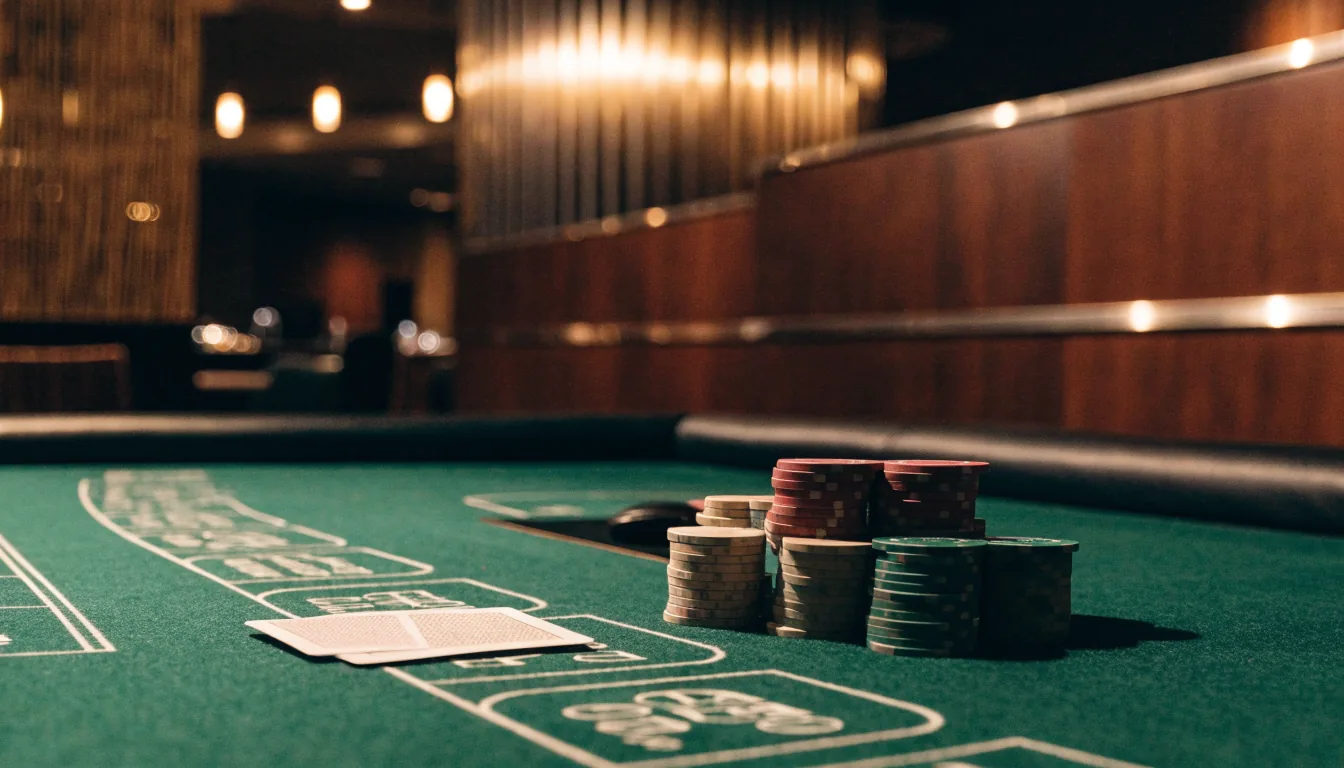
Blackjack Basic Strategy: Decisions Before the Deal
At a blackjack table, the useful question is not whether a hand looks strong in isolation. It is what that hand is likely to do against the dealer’s visible card. A basic strategy chart turns that comparison into a decision: hit, stand, double, or split. It is a decision aid, not a prediction of the next card.
I have found that the chart works best when treated as a lookup tool rather than a set of slogans. First identify the player’s hand, then locate the dealer’s up-card, and read the action at the point where the two meet. A chart is built around the game’s rules, so the table conditions have to match before its recommendation can be applied. Check the table rules before play.
Read the hand, then the up-card
The player’s total alone does not tell the whole story. The same total can call for a different action depending on whether it is a hard or soft hand and what the dealer is showing. A soft hand contains an ace that can count as either one or eleven without immediately forcing the hand over twenty-one. The dealer’s up-card supplies the other half of the decision.
Choosing a casino for game strategies in New Zealand also means checking the basic information available about each operator. This list gives a concise reference point for that review.
-
7Bit Casino
- License
- Tobique Gaming Commission, licence no. 0000091
7Bit Casino is listed with a Tobique Gaming Commission licence, number 0000091. That licence detail is a concrete point to check when assessing the operator.
-
N1 Casino
- License
- Malta Gaming Authority, licence no. MGA/B2C/394/2017
N1 Casino is listed with a Malta Gaming Authority licence, number MGA/B2C/394/2017. The licence information gives readers a specific credential to consider.
-
Lamabet
- Payout speed
- 1-3 business days
Lamabet has a stated payout speed of 1–3 business days. This provides a practical detail to keep in mind when considering the operator.
-
Zotabet
- License
- 07017519840
- Payout speed
- 1-3 business days
Zotabet lists licence number 07017519840 and a payout speed of 1–3 business days. These are the available reference points for assessing the operator.
-
Play Grand
- License
- Malta Gaming Authority, licence no. MGA/B2C/370/2017
Play Grand is listed with a Malta Gaming Authority licence, number MGA/B2C/370/2017. Readers can use this credential as one part of their operator review.
-
Ricky Casino
- License
- Tobique Gaming Commission, licence no. 0000002
Ricky Casino is listed with a Tobique Gaming Commission licence, number 0000002. The licence detail is the available notable point for this operator.
-
BitStarz
- License
- Curaçao Gaming Authority, licence no. OGL/2024/165/0185
BitStarz is listed with a Curaçao Gaming Authority licence, number OGL/2024/165/0185. This gives readers a specific credential to consider.
-
Neospin
- License
- Tobique Gaming Commission, licence no. 0000064
Neospin is listed with a Tobique Gaming Commission licence, number 0000064. The licence information is the available factual point to note.
-
Wintino
- Payout speed
- 1-3 business days
Wintino has a stated payout speed of 1–3 business days. This offers a practical detail for readers reviewing the operator.
The dealer’s procedure matters because it sets the comparison point. Under the stated rule, the dealer draws on a total of sixteen or less and stops on seventeen or higher. A chart calculated for that procedure reflects the dealer’s likely outcomes under that condition. The chart is not simply saying that one player total is “good” and another is “bad”; it is comparing the player’s choices with the dealer’s required play.
The clearest practical example is a hard total from twelve through sixteen against a dealer card of seven or higher. In that situation, the recommended action is to hit rather than stand. Standing can feel like the cautious choice because the hand is already near a total that may bust on another card. But the dealer’s visible card changes the calculation: the chart favours taking a card over waiting on that hard total. It is a probability decision, not a promise that the next card will help.
What each action means
Hit means taking another card. The chart points to a hit when the expected result of drawing is preferable to stopping with the current hand, even when there is a risk of going over twenty-one. That risk is part of the decision, not evidence that the chart has failed.
Stand means taking no more cards. It is the chart’s instruction when keeping the current total compares better with drawing or changing the wager. A hand that feels uncomfortable can still be a stand in the right matchup; a hand that looks respectable can still call for a hit against a strong dealer up-card.

Double changes the wager and limits the player’s next step to the card dealt under the game’s procedure. The chart indicates when increasing the wager is preferable to simply taking another card. It is not a general instruction to raise stakes when confidence is high. The decision is tied to the hand and the dealer’s up-card.
Split turns a qualifying starting hand into separate hands by placing another wager. It is therefore not just a way to improve the shape of a hand: it also changes how much is exposed and how many hands are being played. Pair decisions have their own practical conditions, so the chart’s split instruction needs to be read alongside the table’s rules.
These actions can be easy to remember as words and easy to misapply at the table. A player may choose to stand because the total feels safe, or hit because drawing seems active. Neither feeling is the method. The chart replaces that instinctive reaction with a consistent choice for the particular matchup.
Use the chart as a decision map
A casino blackjack strategy card is useful because it reduces the number of decisions being improvised during a hand. It does not remove the need to identify the hand correctly or to know the dealer’s rule. If the hand is misclassified, or the chart is for different conditions, the lookup can produce a confident but unsuitable answer.
The same point applies to an online casino blackjack strategy guide or a chart kept beside a live game. The format of the reference does not change the underlying task: match the hand to the dealer’s up-card, then follow the indicated action for that game. During play, the chart is a compact map. It is not a system for controlling the cards.
Under the stated rules, basic strategy reduces the house edge to 0.43%. That figure describes the effect of making the chart’s decisions consistently under those conditions; it does not mean that any individual hand or session will be profitable. A sound decision can still lose when the next card goes the other way. The discipline is in repeating the correct choice, not judging the method by a single result.
I would also separate strategic decisions from table administration. A chart cannot make an unsuitable wager affordable, and it cannot correct a misunderstanding about the rules. Set a budget and a time limit before playing, and use only money that can be lost without affecting essential expenses. Then check the table rules, confirm the dealer procedure, and use a chart that matches the game.

No dramatic system is needed. The chart answers one narrow question at a time: given this hand and this up-card, which available action is strongest under these conditions? Read that pairing accurately, and the decision becomes less about nerve and more about method.
Roulette Systems and the Cost of Each Bet
A roulette betting system is a way of choosing and arranging wagers. It can change how much is staked from one turn to the next, or which outcomes receive a wager. It cannot change the house edge built into American roulette. That distinction is easy to lose when a sequence of bets is presented as a “strategy”: the pattern may shape the session, but it does not alter the underlying cost of wagering.
American roulette has a house edge of 5.26%. The figure applies to the total amount wagered over play, not simply to the money brought to the table at the start. A starting bankroll is a snapshot; total wagering accumulates as bets are placed. The two amounts answer different questions. One describes the funds set aside for a session, while the other describes the activity to which the house edge applies.

That is why a betting plan cannot be assessed just by asking whether it might produce a winning turn. A session can end ahead or behind, and an individual result can depart from the long-run expectation. But changing the size or sequence of wagers does not erase the edge on the wagering that takes place. The arithmetic remains in view. Patterns do not rewrite it.
What a system changes
Flat betting keeps the stake at a consistent level. A double-up approach increases the next wager after a loss, in the hope that a later win will recover earlier losses. Other systems vary the stake in response to wins or losses. These approaches differ in how they distribute money through a session; none creates a more favourable roulette outcome.
A sequence can feel persuasive because it gives each decision a rule. After a loss, the next stake may look like a deliberate recovery plan rather than another wager exposed to the same game. After a win, a system may instruct the player to raise or reduce the stake. The instruction is visible, while the unchanged house edge is less visible. From the operator’s side of the counter, that is the practical gap between a betting pattern and an advantage: the pattern organises action, not probability.
A “winning system” is especially misleading when it treats a short run of results as evidence that the next wager has improved. A previous result can determine what a system tells the player to stake next, but it does not remove the house edge from that stake. Nor does a larger wager make a loss easier to absorb. It increases the amount exposed in that decision.
Bankroll is not total wagering
The difference between starting funds and turnover matters when comparing systems. A player might bring a set bankroll and place repeated wagers during the session. Each new wager contributes to total wagering, even if some of the money being staked came from earlier wins. The starting amount alone therefore does not show the full volume of play.
This is the part that marketing language often leaves in the background. “Recover your losses” describes an intended path through a sequence, not a change to roulette’s edge. A system can call for larger stakes after losses, but those wagers still count toward total wagering. If a later win does not arrive, the larger stakes can make the session’s loss more severe. No pattern guarantees recovery.
The same distinction applies when a strategy is described as a way to “win” at roulette. A player can finish a particular session ahead; that outcome does not demonstrate that the system removed the house edge. The claim becomes stronger than the mechanics support when it suggests that a stake sequence can ensure a profitable result. It cannot.

A practical way to assess the claim
When a roulette system is presented as a method for beating the game, the useful questions are basic: does it change the game’s house edge, or only the timing and size of wagers? Does its explanation focus on the starting bankroll while leaving total wagering unmentioned? If the selling point is a guaranteed recovery or a sure win, the language is doing more work than the system.
The same caution applies to “best” strategy claims. A plan may suit someone who wants a consistent stake, or someone who prefers a rule for changing stakes. That is a preference about session structure, not proof of a mathematical advantage. Roulette’s 5.26% house edge in the American version remains the relevant figure; a betting pattern does not reduce it.
I would separate a plan for controlling exposure from a claim about changing the odds. Setting a budget and a time limit before play can define when a session ends. Playing only with money that can be afforded to lose keeps the decision grounded in the cost of the activity. Neither step turns a system into a winning method. They set boundaries. Nothing more.
A roulette strategy can organise choices, but it cannot make the edge disappear. The point is not whether a sequence looks disciplined or whether it has a memorable name. The point is what happens to total wagering as the sequence unfolds. Keep that measure in view, and claims about doubling up or guaranteed wins are easier to judge for what they are: staking instructions, not a route around the house edge.
Split Aces, Pair Decisions and the Chart’s Limits
A pair decision changes more than the shape of a hand. Splitting means placing a second wager equal to the first, then receiving an additional card for each resulting hand. One starting hand has become two hands, with more money exposed and more outcomes in play. That is the practical cost behind a chart instruction to split.
A blackjack chart is useful only when its assumptions match the table. It does not turn every pair into a split, and a recommendation is not a promise of a better result on that particular deal. I treat pair decisions as conditional instructions: the pair, the dealer’s visible card and the table rules all matter.
Some pairs are poor candidates. Splitting fours, fives or tens is generally not advised because it rarely improves the odds. The temptation is understandable: two hands look like two chances. But the new hands start with a card removed from each pair, and the extra wager does not make that starting position inherently stronger. More action is not the same as better value.
Aces need separate treatment. In American-style blackjack that uses hole cards, basic strategy calls for splitting a pair of aces against any dealer up-card. European-style blackjack without a hole card handles the dealer-ace situation differently: against an ace, the relevant play is to hit soft 12 rather than split aces. A chart built for one dealing format should not be carried over automatically to the other.

The rules after the split matter as much as the initial decision. Standard blackjack does not allow a player to hit split aces; each ace generally receives only one additional card. A ten-value card alongside a split ace makes a regular 21, not a natural blackjack. It is not an automatic win: if the dealer also has 21, the hands tie. That distinction is easy to miss when the result looks like a blackjack.
Resplitting is another rule to check. If another pair of aces appears after the first split, a chart may call for splitting again where the rules permit it. Some casinos allow this, while others restrict it; a further split also creates another hand and requires another bet. I would not apply an ace-splitting recommendation at a table that prohibits the relevant resplit or hitting conditions. Check the table rules first.
Splitting therefore adds exposure and variance, even when the chart supports the decision. A blackjack strategy chart for an online casino is still only as suitable as its assumptions about the game. The same principle does not supply a baccarat strategy or a crypto-casino system: those are different contexts, and a blackjack pair chart cannot answer them.
Before play, the sensible frame is a set budget and a time limit, using only money that can be lost without affecting essential expenses. When a split asks for another wager, that cost is visible at the felt. Keep it visible.
Casino Games Beyond the Blackjack Table
“Casino strategy” covers games that ask for very different kinds of decisions. A method built around choosing how to play a hand cannot simply be carried over to a slot or a football-themed studio game because the category names share the casino floor, not a common set of rules.
Blackjack
Involves player choices that can affect the game; played optimally, it sits at the low end of house advantage.
Video Poker
Like blackjack, it involves decisions that can result in a lower house advantage under optimal strategy.
Slots
Studio formats where blackjack-style decision charts do not apply; they have different decision structures.
The useful comparison is narrower. With optimal play, blackjack and video poker sit at the low end of house advantage among casino games. That is a comparison about how the games perform when decisions are made correctly; it is not a claim that the same decisions, or the same kind of strategy, apply to every game.
I have found that promotional language often makes “strategy” sound like a universal tool. In practice, the word can mean very different things: selecting an action during a hand, choosing how to play a poker draw, or following a preferred routine at a game with another format. The label alone says little. The game’s decision points matter.
Where the comparison applies
Blackjack and video poker both involve player choices that can affect the way a game is played. Under optimal strategy, both can have lower house advantages than other casino options. That makes them relevant when comparing games by this measure, but it does not turn a favourable comparison into a promise of profit. A lower house advantage is not the same as an assured result.
Nor does the comparison mean every version of either game has identical conditions. The practical value of a strategy depends on the game being played and the choices it allows. A player moving between formats needs to understand what decisions are available in the new game rather than assuming that a familiar casino routine still fits.
That distinction is easy to miss. “Best strategy” is an attractive phrase because it sounds complete. The real question is narrower: best for which game, under which rules, and for which decision? The phrase is not a method by itself.

Slots and studio formats
Slot play and football-themed studio games may appear alongside blackjack and video poker in broad casino discussions, but their presence in the same setting does not establish that a blackjack-style decision chart applies to them. A strategy should describe actual choices within a game, not just a general approach to betting or play.
That is where restraint matters. A system described as a slot strategy should not be treated as equivalent to optimal play in blackjack or video poker merely because all are casino products. Likewise, a football studio format should be assessed on its own mechanics, not folded into a blackjack comparison. The shared word is “casino”; the decision structure may be entirely different.
I prefer to separate the measurable comparison from the sales language around it. Blackjack and video poker have the stated advantage when played optimally. That does not certify a universal casino strategy, and it does not make a routine transferable to slots or studio games. Different game, different decisions.
In practical terms, a broad strategy search is best read as a request to identify what kind of decision a game actually offers. The lower-house-advantage comparison belongs to blackjack and video poker under optimal play. Other formats should not inherit that conclusion by association. No shortcut.
Casino War Betting: Keep the Wager in View
A casino war betting strategy is often presented as a choice about how much to stake after a particular result. The word “strategy” can make that sound like a way to change the game’s underlying odds. It is not. A staking pattern changes the size and sequence of wagers; it does not, by itself, remove the house edge.
Do
- Set a budget and time limit before play
- Use only money that can be afforded to lose
- Track total wagering across the session
Don’t
- Treat the starting bankroll as the full measure of exposure
- Rely on a staking progression to remove the house edge
- Extend play specifically to recover losses
The distinction that matters is between a starting bankroll and total wagering. A bankroll is the amount set aside at the outset. Total wagering is the sum of the stakes placed as play continues. The house edge applies to that total, not just to the opening bankroll. A modest initial stake can therefore be put at risk repeatedly, while a larger bankroll does not automatically mean a larger amount will be wagered. The two measures answer different questions.
That is the point easily lost in a betting pitch. A run of wins or losses may change what is available to stake next, but it does not turn a progression into a mathematical advantage. Nor does a fixed stake make the house edge disappear. It can keep the pattern of wagers simple; it cannot rewrite the game’s terms.
I have seen “control” used as an advertising word for a betting plan. In practice, control means only that the player has chosen a way to vary, or not vary, the stake. It is not control over the outcome. Without a verified game-specific basis, claims that a particular sequence improves casino war results should be treated as claims, not as established strategy.
For the same reason, a casino betting strategy should be judged by what it actually changes. Does it alter the amount placed at risk over time, or merely describe how stakes are arranged? Those are not equivalent. A plan that increases stakes after losses can make later wagers larger, but that does not establish that the sequence has improved the odds. A plan that keeps stakes level also cannot guarantee a favourable session.

A sound personal framework starts before play: set a budget and a time limit, and use only money that can be afforded to lose. Keep track of the amount wagered across the session rather than treating the starting bankroll as the full measure of exposure. Stop when the planned limit is reached; extending play to recover losses adds further wagering without changing the house edge.
No magic sequence. Just exposure.
Bonus Strategy Without Unsupported Promises
Deposit offers and bonuses that do not require a deposit can make a casino promotion sound like a separate way to play. The wording is only the start of the calculation. A headline does not establish what an offer is worth to a particular player, who can claim it, or what conditions apply. I would not treat an advertised bonus as extra bankroll until those details are known.
The same caution applies to claims about a bonus suited to high-volatility games. “High volatility” describes the pattern of results, not a change to the house edge. It does not, by itself, show that a bonus will last longer, produce a better return, or be easier to use. Without the terms of a specific offer and the rules of the game, those conclusions have no sound basis.
The underlying arithmetic is less flexible than the promotional language. House edge applies to the total amount wagered over play, not simply to the money first brought to the table. A starting bankroll is a snapshot; wagering accumulates as play continues. A bonus may affect how much is available to stake, but it does not make the total amount wagered the relevant figure disappear.
That distinction is easy to miss because offers are presented as a credit or reward, while the cost of play is spread across repeated decisions. The label can draw attention to the initial balance. The mechanics remain tied to the wagering that takes place. No promotional phrase changes that relationship.
For a deposit bonus, the word “match” can sound like a direct addition to funds. For a no-deposit offer, “free” can sound as though there is no trade-off. Neither description, by itself, establishes usable value. Eligibility, restrictions and other conditions matter, and they cannot safely be inferred from the offer’s title. I have seen how a short headline can carry more certainty than its details justify. Read the fine print. Then assess the offer.
This is not an argument that every promotion is poor value. It is a limit on what can responsibly be claimed without the specific terms in view. A bonus strategy cannot be reduced to selecting a promotion by its size, label or association with a particular style of game. Nor does a larger starting balance mean the house edge applies only to the original deposit.
The practical measure stays the same: total wagering, not the opening bankroll. Promotions may change the balance displayed, but they do not turn that balance into a guaranteed return or remove the game’s house edge. The headline is not the calculation.
Craps and the Limits of a “Winning” Strategy
A promise of a “winning” craps strategy often sounds more precise than it is. It may describe a betting routine, a set of choices or a way to organise play, but the label does not establish that the routine changes the game’s underlying advantage. A method can shape how wagers are placed without guaranteeing a winning hand or session.

I have seen the distinction get blurred in casino language. “Strategy” sounds like a way to control the result; in practice, it can mean little more than a repeatable plan for making decisions. That can help keep play orderly, but order is not the same as an improved mathematical return. The claim needs to be judged by what it changes, not by how confidently it is presented.
The key accounting point is the difference between a starting bankroll and total wagering. The house edge applies to the sum wagered over play, not simply to the amount brought to the table. A bankroll is a pool of money available for decisions. It is not, by itself, the measure used to describe the edge. If play involves repeated wagers, the total action can exceed the original bankroll as funds are won and wagered again.
That distinction matters when a strategy is described as a way to “make a bankroll last” or “win back” earlier losses. Those phrases describe an intended experience, not proof that the edge has changed. A session may finish ahead or behind; neither result establishes that a betting pattern has removed the house edge. Nor does a short run of favourable outcomes validate a general claim.
For craps, a useful way to assess a proposed system is to separate its practical purpose from its mathematical promise. A routine may make decisions feel more consistent or limit how often choices are reconsidered. Those are organisational effects. They do not justify calling it a reliable route to profit. Without a demonstrated change to the game’s advantage, a sequence of wagers remains a sequence of wagers.
The same caution applies to an online version. A digital table does not turn a betting pattern into a guarantee. The word “online” describes where the game is played, not evidence that a system can overcome its underlying economics. Claims about a sure method deserve particular scepticism when they rely on confident language rather than a clear explanation of what changes.
I treat bankroll planning as loss management, not as a winning system. Set a budget and a time limit before play, and use only money that can be lost without affecting essential expenses. Stop when either limit is reached. No recovery plan.
House Edge, Wagering and Long-Term Outcomes
House edge is easiest to misunderstand when it is compared with the cash brought to a table. It applies to the total amount wagered over play, not simply to the starting bankroll. A bankroll is the amount available to absorb results; total wagering is the sum of bets made as play continues. Those are different measures, and treating them as interchangeable can make the expected cost of play look smaller than it is.
I have seen “low edge” used as if it meant low risk. It does not. It describes a mathematical advantage held by the casino across wagering, not a promise about the result of a particular hand or session. Short-term outcomes can vary, and a player can lose more or win more than an average expectation suggests. The edge is a long-run measure, not a forecast for an individual visit.
For blackjack, the conditions matter. In a typical shoe game with favourable rules and a 3:2 payout for blackjack, basic strategy leaves the casino with an edge of approximately 0.5%. That is a small figure in comparison with many casino games, but it still applies across the amount wagered. Playing correctly does not remove the edge or make a session predictable.

This is why the “best strategy” is not a staking pattern that promises a result. It is a way of making decisions that fits the game’s rules and reduces avoidable mistakes. The distinction is plain: decision quality can affect the house edge; it cannot turn the game into a guaranteed income source. Check the table rules before applying any strategy, since the estimate depends on the conditions of play.
In practice, I treat the edge as a cost of participation, not as a reason to stretch a session. A set budget and time limit help keep that distinction visible, and play should be limited to money that can be lost without affecting essentials. Once the planned amount or time is reached, continuing does not improve the underlying odds. More wagering means more exposure to the house edge, even when the game is being played well.
The useful comparison is therefore not “how much was brought” against “how much was won” in a single stretch. It is whether the game’s rules and decisions are understood, and whether the total wagering remains within a deliberate limit. No certainty.
Online Strategy Still Depends on the Table Rules
The format does not determine the blackjack strategy; the rules do. I have seen the same chart treated as a universal instruction sheet, then blamed when its recommendations did not fit the table. Online, live-dealer and land-based games can use the same basic strategy chart, but only when the game rules match the chart’s assumptions.
That means checking the details before play begins. A chart built for a dealer who stands on soft 17 may give different advice from one intended for a dealer who hits soft 17. Whether surrender is available also affects recommendations. A familiar layout or a fast-moving live table does not make those differences disappear.
Small print matters.
For online and live-dealer blackjack, the relevant rules should be visible in the game information; at a physical table, they may be posted or confirmed by staff. I treat that check as part of selecting the right chart, not as an administrative extra. If the chart and table disagree on a rule, the chart is not a reliable guide for that game.
This is where claims of “winning online casino strategies” tend to overreach. Basic strategy gives a way to make decisions consistent with the rules; it does not guarantee a winning hand or session. Nor does moving from a physical table to a screen improve the underlying decision logic. The interface changes. The rules still govern.
A useful way to compare formats is to record the conditions that affect the chart: the dealer’s soft-17 rule and whether surrender is offered. Then use a chart designed for those conditions. A chart that matches an online game may also match a live-dealer or land-based game, but the format alone is not enough to establish that.
I do not treat a strategy label as proof that a game is suitable. The practical test is whether the chart corresponds to the table actually being played. If it does not, switching formats will not fix the mismatch; finding the correct chart, or choosing a game whose rules fit the chart, will.
Before playing, set a budget and a time limit, and use only money that can be lost without affecting essential expenses. Strategy is a decision aid, not a safety net.
Martingale Claims and the Cost of Repeated Bets
A martingale is commonly presented as a way to respond to losses by increasing later stakes. The pitch makes the sequence of bets the focus: a loss is framed as temporary, while a future win is treated as the point at which the sequence turns around. That framing can make a staking pattern sound like a change to the game itself. It is not.
The house edge applies to the total amount wagered, not merely to the money brought to the table at the start. Repeated bets therefore matter. A player may begin with a fixed bankroll, but if that bankroll is wagered again and again, the relevant exposure is the accumulated wagering. Changing stake sizes does not remove the house edge from those wagers.
I have seen “strategy” used in casino marketing as if it were a property of the game. The word can describe a decision process, a staking pattern, or simply a sales label. Those are not interchangeable. A betting progression changes how money is distributed across successive wagers; it does not, by itself, change the underlying house edge. A confident presentation is not evidence of a different mathematical outcome.
This is where claims of a reliable recovery plan need particular care. A sequence that depends on continuing to place bets still depends on having money available to place them. The starting bankroll is not the same measure as total wagering, and the distinction can disappear in promotional language. No staking pattern should be treated as a guarantee of a winning hand or session.
Online casino marketing examples often use “smart,” “structured” or “disciplined” to make a system sound safer or more effective. The useful question is narrower: does the claim explain how the game’s house edge changes? If it only describes a different order or size of bets, the edge on total wagering remains the central point. A persuasive name cannot alter that accounting.
I would separate the presentation from the mechanism. Read a betting system as a way of arranging wagers, not as proof that the game has become more favourable. Set a budget and a time limit before playing, and use only money that can be lost without affecting essential expenses. Repeated bets add up. The label does not.
What is blackjack basic strategy?
Blackjack basic strategy is a chart-based method for choosing whether to hit, stand, double, or split based on your hand and the dealer’s up-card. Use a chart that matches the table’s rules.
What is the house edge with basic strategy?
Under the stated rules, basic strategy reduces the blackjack house edge to 0.43%. This is an average over play, not a guarantee that an individual hand or session will win.
Can you double down after splitting?
Some blackjack rules allow doubling after splitting, and basic strategy charts commonly assume that it is allowed. Check the table rules, since they can differ.
Safety & Guides for New Zealand Casinos
Content created by the «casinobonusinfonz.com» team