
Understand the Table Before You Place a Bet
 Available in US
Each hand is judged against the dealer, while table rules shape the decisions available to players.
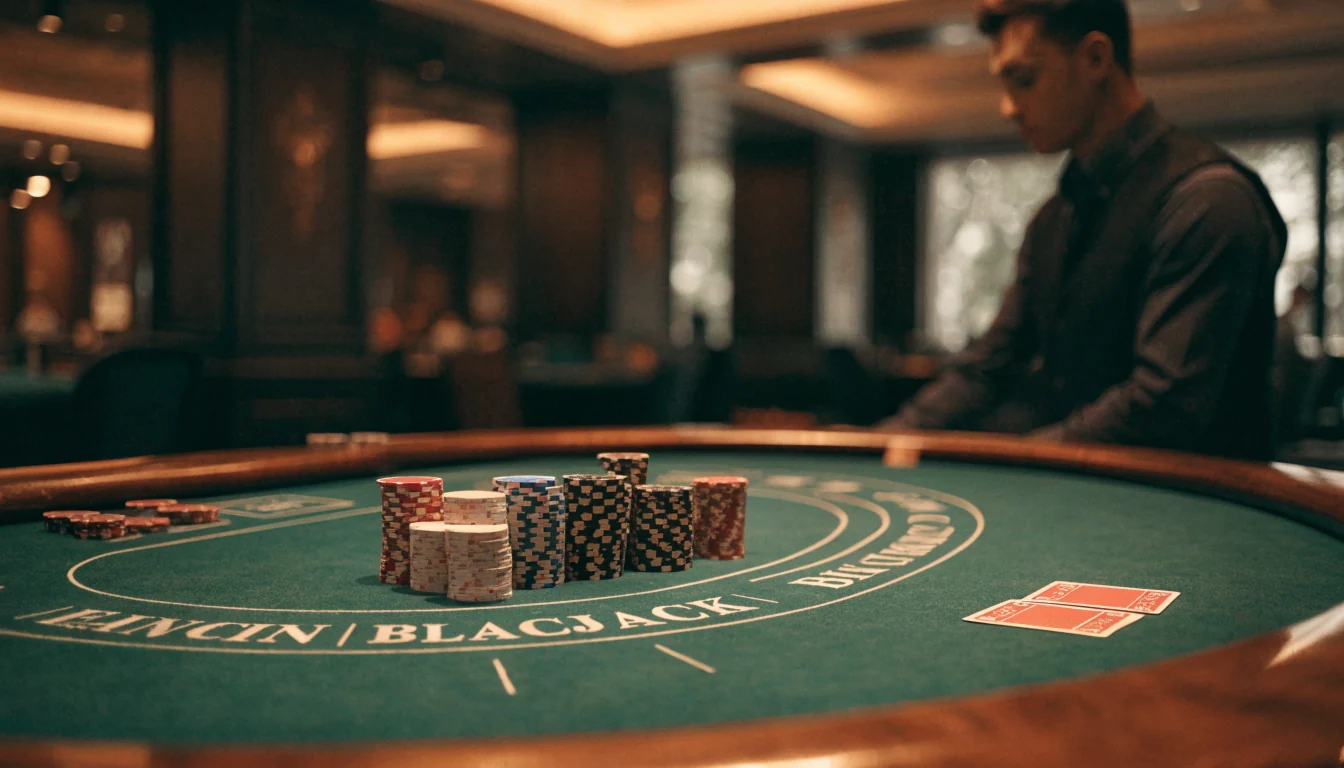
How Blackjack Plays at a Casino Table
Blackjack is a contest between each player and the dealer, not a competition among the people seated around the table. The aim is to finish closer to 21 than the dealer without going over. That simple structure shapes the whole experience: several players may act in turn, but each hand is judged against the dealer’s hand.
At a physical casino table, the dealer manages the cards and the pace of the round. Players sit along one side of the curved table, with the dealer opposite them. The layout gives each position a place for a hand and keeps the dealer’s cards and actions visible. The seats share the same game, but each player makes decisions about their own hand. One person’s result does not determine another’s.
That distinction matters more than the table’s appearance. A blackjack table can feel social, with conversation and a shared rhythm, yet the game is still made up of separate contests against the dealer. A player may watch other hands while waiting for a turn, but those hands do not become partners or opponents in the same way the dealer is. The dealer is the common point of comparison.
I have found that the physical setting makes the sequence easier to follow. Cards are handled in view, the dealer’s movements mark each stage, and the other players’ turns provide a visible rhythm. A new arrival can often understand where attention is directed just by watching: the dealer, the cards, then the player whose turn it is. The room contributes atmosphere, but the mechanics remain direct. No hidden team game.

A live blackjack table online reproduces much of that dealer-led sequence through a video stream. The cards are real, handled at a table and shown to players remotely. That makes it different from a computer-generated blackjack game, even when both appear on a screen. In the live version, the camera carries the view of an actual table; in the other, software presents the game without a physical dealer dealing those cards.
The practical difference is not merely visual. A streamed game depends on the video and the connection between the table and the player. That can introduce delay, so the round may feel less immediate than sitting in the room. Some live games may also require higher bets than a player expects. Those are operational differences, not a change to the basic dealer-versus-player objective.
A casino blackjack table in a room gives direct sightlines and a shared physical pace. An online live table gives a camera view instead. Neither description tells the whole story of the experience: one places the player among other people at the table, while the other presents the table through a stream. The underlying contest remains recognizable, but the surrounding cues differ.
That distinction helps when comparing a live casino table with an online casino table. The phrase “live” can sound like a promise of a seamless experience; in practice, it means that actual cards and a dealer are involved, while the player watches remotely. A stream can make the table visible, but it cannot remove the delay that streaming may bring. The format has a real table behind it. The player is not physically there.
The layout also gives the game its order. Each player has a defined place, and the dealer addresses hands around the table as the round progresses. That structure prevents the game from becoming a scramble of simultaneous decisions. There is a turn-taking pattern, even though the people at the table are all playing against the same dealer. In a streamed game, the camera and interface preserve that order for remote participants.
A “21” table may be described by the target number, but the central idea is not to reach that number at any cost. The aim is to end nearer to it than the dealer without exceeding it. That leaves room for different outcomes and explains why the game is a comparison of hands rather than a race to make a particular total.
The table experience is therefore a mix of a clear objective and a particular setting. Physical cards, a visible dealer and the pace of other players define the casino-floor version. A live stream keeps the actual cards but adds the distance and timing of video. I treat those as different ways of encountering the same basic game, not as identical experiences. One is present. One is mediated.
The Rules That Change the Price of a Blackjack Hand
A blackjack table’s printed rules do more than describe how a round proceeds. They determine how certain hands are settled and which options are available. That is why two games with the same name can have different terms for a natural blackjack, different dealer instructions and different surrender rules. The details matter before a hand is dealt.
A natural blackjack is an opening hand made up of an ace and a card worth ten. Its payout is separate from the return on an ordinary winning hand, so the stated ratio is worth reading carefully. A specialist review reports tables with a natural-blackjack payout of 3:2 and others with a payout of 6:5. Those are different terms, not two ways of writing the same offer: the ratio states what the casino pays in winnings relative to the original wager when that hand qualifies.

That difference affects the value assigned to a natural, but it does not describe every part of the game. A table can offer one payout while also applying its own conditions to the dealer’s play, the number of decks or the player’s available actions. The payout line should therefore be read alongside the rest of the rules, rather than treated as a complete summary of the table.
The rules printed for the game
A specialist review notes that blackjack games can vary in deck count, natural payouts, surrender terms and whether the dealer hits or stands on soft 17. These are conditions of the particular game, not details that can safely be assumed from the word “blackjack” alone. The table’s rule display is the useful reference: it sets out how that version is run.
Deck count describes the cards used in the game. It is a rule feature, not a promise about a particular outcome. A player may encounter a game using a different number of decks from another table, even where the basic aim and familiar card actions remain the same. The number matters as part of the game’s specification; it does not, by itself, tell the full story of how a hand will finish.
Soft 17 is a dealer hand containing an ace counted as 11 without taking the total above 21. The relevant rule says whether the dealer must take another card or stop on that total. The distinction belongs to the house procedure: it is not an optional choice made after seeing how the round develops. In a clear rules panel, the dealer’s instruction should be stated directly.
Surrender is another rule-dependent option. Where it is offered, the player can give up the hand under the game’s stated conditions rather than continue it. Where it is not offered, that option is unavailable. Its presence should not be inferred from a general description of blackjack, because games can differ on this point.
Deck Count
Describes the number of cards used in the game, which is a rule feature and part of the game's specification.
Soft 17
A dealer hand with an ace counted as 11; rules dictate if the dealer must hit or stand on this total.
Surrender
An option that allows a player to give up the hand under specific stated conditions.
Natural Payout
The ratio paid for an opening hand of an ace and a ten-value card, such as 3:2 or 6:5.
The action menu is not the whole rulebook
The familiar choices are to hit, stand, double down, split or surrender, depending on the table rules. A game may not make every action available in every situation, and the rules determine the conditions attached to them. A short label or promotional description can name the options without explaining those conditions; the detailed rules are where the working terms sit.
This is also why a “blackjack table price” is not one figure. The phrase can mean the financial effect of a payout rule, but it should not be confused with a table’s betting limits or with the size of a wager. A natural payout ratio concerns how a qualifying hand is settled. Other game rules shape what happens during play. They are related parts of the offer, but they answer different questions.
The practical check is to read the payout, dealer instruction and action terms as one set. A 3:2 natural payout does not tell whether the dealer hits soft 17; a stated deck count does not establish whether surrender is available. The wording has to be checked rule by rule, on the specific game being played.
Those conditions are the game. Not the label.
Online Blackjack in New Zealand: The 2026 Licensing Transition
Choosing a blackjack table in New Zealand involves considering the operator as well as the game. This list provides a concise reference to the operator details available for this page.
-
7Bit Casino
- License
- Tobique Gaming Commission, licence no. 0000091
7Bit Casino lists a licence from the Tobique Gaming Commission, number 0000091.
-
N1 Casino
- License
- Malta Gaming Authority, licence no. MGA/B2C/394/2017
N1 Casino lists a Malta Gaming Authority licence, number MGA/B2C/394/2017.
-
Lamabet
- Payout speed
- 1-3 business days
Lamabet lists a payout speed of 1–3 business days.
-
Zotabet
- License
- 07017519840
- Payout speed
- 1-3 business days
Zotabet lists licence number 07017519840 and a payout speed of 1–3 business days.
-
Play Grand
- License
- Malta Gaming Authority, licence no. MGA/B2C/370/2017
Play Grand lists a Malta Gaming Authority licence, number MGA/B2C/370/2017.
-
Ricky Casino
- License
- Tobique Gaming Commission, licence no. 0000002
Ricky Casino lists a licence from the Tobique Gaming Commission, number 0000002.
-
BitStarz
- License
- Curaçao Gaming Authority, licence no. OGL/2024/165/0185
BitStarz lists a Curaçao Gaming Authority licence, number OGL/2024/165/0185.
-
Neospin
- License
- Tobique Gaming Commission, licence no. 0000064
Neospin lists a licence from the Tobique Gaming Commission, number 0000064.
-
Wintino
- Payout speed
- 1-3 business days
Wintino lists a payout speed of 1–3 business days.
An online blackjack table can be a software game or a live-dealer stream, and the distinction is more than visual. In RNG blackjack, software shuffles the cards, so hands can be dealt and resolved faster. A live-dealer game uses physical cards dealt at a studio table and sends the action over a stream; that can feel closer to a casino table, but streaming may introduce delays or come with higher betting requirements.
The format does not, by itself, establish whether a provider may legally offer the game in New Zealand. That question changed with the Online Casino Gambling Act 2026, which took effect on 1 May 2026 and created the country’s first domestic licensing system for online casino gambling. The transition is deliberately staged. A familiar site name or a polished blackjack table is not proof that the operator holds a New Zealand licence.
What the transition permits
New Zealand has not permitted online casinos to be based domestically under the Gambling Act 2003. Before the new Act, offshore online casino gambling had no New Zealand licensing or regulatory supervision. A customer using an offshore site in that period therefore had no domestic government route for resolving a dispute. That distinction matters: the new framework changes oversight of providers, rather than turning a game’s presentation into a safeguard.

During the transition, only online casinos that were already serving people in New Zealand before 1 May 2026 may keep operating, and only under the Act’s transitional provisions. The permitted period runs until 1 December 2026. A provider that has not applied for a licence by then must stop conducting online casino gambling in New Zealand. If an application is declined, the provider must cease those operations and leave the market.
The Gambling Commission hears and decides licensing applications. It also issues online casino licences and approves changes to licence conditions. The Department of Internal Affairs oversees the licensing framework and remains New Zealand’s primary gambling regulator. These are related but distinct roles: the Commission makes licensing decisions, while the Department has the broader oversight function.
A transitional provider is not the same thing as a licensed provider. The full licensing regime is not expected to be fully operational until 2027, and unlicensed operation is expected to become an offence around mid-2027. Providers that operate without a licence may face enforcement action and fines of up to NZ$5 million. The milestones have practical consequences. A provider’s eligibility to continue during transition depends on when it was already operating and whether it meets the application requirements—not simply on whether its online blackjack table remains accessible.
Advertising and player checks
The transition also restricts promotion. Online casino gambling must not be advertised to people in New Zealand during this period. Once licensed operators are able to advertise under the regime, permission will be tightly constrained, and sponsorships are prohibited. A promotional message should not be mistaken for evidence that a service is licensed or that a transitional exception applies.
Licensed operators must use stricter age and identity verification systems. These checks are part of the operating conditions, not an optional feature of the blackjack software. RNG and live-dealer games can look very different on screen, but neither format determines the provider’s licensing status or removes the need for verification.
From the other side of the counter, the key distinction is between a game interface and the business behind it. A streamed dealer can make an online table look like a physical casino; fast software play can make an RNG table feel routine. Neither tells the whole regulatory story. The transition is about provider eligibility, licensing decisions, and compliance—not the appearance of the cards.
Strategy Starts with the Rules, Not a Betting System
Blackjack strategy is often sold as a system: memorise a chart, follow it, and supposedly put the game under control. That framing leaves out the first job. The right reference depends on the version being played. Rules can change both the decisions that make sense and the house edge, so a strategy detached from the table conditions is incomplete.

I learned to treat the posted rules as part of the game, not fine print to skim after choosing a seat. The number of decks, the dealer’s treatment of soft seventeen, surrender availability and the natural-blackjack payout are among the conditions that can differ from one game to another. A change in a rule can alter the calculation behind a decision. The name “blackjack” does not promise identical conditions.
A chart has a particular job
A basic-strategy chart is a reference for decisions under a specified set of rules. It is not a prediction of the next hand, and it does not turn a variable game into a fixed outcome. If the chart assumes different conditions from those at the table, copying it precisely can still mean applying the wrong strategy.
The same caution applies to a probability table or a surrender reference. These tools can organise information, but their usefulness depends on what game they describe. A surrender option, for instance, matters only where the rules provide for it; a reference built around that option cannot simply be carried over to a game without it. Check the conditions first. Then use the tool.
A blackjack pay table belongs in that check, too. Payout terms are not decoration: they affect the value of a natural and, with it, the economics of the game. I do not treat an appealing chart or a familiar table name as proof that the underlying conditions match. Small print does real work.
Why betting systems do not repair the rules
A progression that increases or decreases stakes after wins or losses changes the pattern of bets, not the rules of blackjack. It cannot make a less favourable set of conditions more favourable by itself, nor guarantee a winning session. The tidy sequence is the sales pitch. The underlying game remains.
Do
- Identify the specific version of the game
- Understand the rules and what they permit
- Use a reference suited to the table conditions
Don't
- Rely on a strategy detached from table rules
- Assume a betting system removes the house edge
- Treat a basic-strategy chart as a warranty
That distinction matters because a strategy discussion can slide into claims about control. Decisions may be informed by the rules, but no betting pattern removes the house edge built into a particular variant. A private blackjack table does not automatically change that. Privacy describes the setting, not a mathematical advantage; the relevant conditions still need to be known.
My practical conclusion is plain: identify the version, understand what its rules permit, and only then rely on a reference suited to it. A chart is a tool, not a warranty. No system overrides the table.
Card counting and the limits of the claim
Card counting is another subject often wrapped in claims that go further than the facts. In New Zealand, using mental calculation to count cards is not illegal. That legal point should not be confused with a promise that counting will produce an edge, or that it applies equally across games and formats.
The method depends on information from cards already dealt, while the conditions of play determine whether that information can be put to use. A legal method is not automatically practical, and legality is not a guarantee of profit. I keep those questions separate.
Strategy works best as a way to make decisions consistent with the rules in front of the player. It cannot erase differences between variants, transform a betting system into an advantage, or promise a result. Read the conditions first. Then decide whether the strategy actually fits.
Chips, Bets and Electronic Blackjack
At a physical table, chips make the stake visible. A player chooses chips, places them in the betting area before a hand begins, and adjusts the stake between hands. That small ritual creates a pause: the amount is on the felt, and changing it is a deliberate act. The dealer and other players can see the wager, but the chips do not change the underlying rules or make a hand more likely to win.
An electronic blackjack table replaces that physical exchange with a screen and controls. The stake is selected digitally rather than built from chips, and the game records the bet through its interface. The format can feel less social than a table with a dealer and other players. It can also remove some of the natural pauses that come with handling chips and waiting for a live game to proceed.
The practical difference in pace matters. RNG blackjack uses software shuffles and can move faster than a live-dealer game. More hands may pass in the same stretch of time. That does not improve the value of a bet; it can simply mean that a set budget is used more quickly if the stake stays constant. I have seen pace mistaken for control. It is not.
A budget is useful before play starts because it puts a boundary around the session, rather than leaving each new bet to react to the last result. Increasing stakes to recover losses changes the amount exposed without undoing what has already happened. Loss-chasing is a familiar way for a session to outlast the plan. A firm stopping point is less dramatic—and more practical.
Promotional funds need separate attention. The headline offer rarely tells the whole story. The terms may define which games count towards wagering requirements, and blackjack may contribute differently from other games. A maximum-bet rule can also apply while wagering requirements are being met. A stake that appears acceptable on the table may therefore conflict with the offer’s conditions.
- Verify which games contribute towards wagering requirements
- Check the blackjack-specific contribution rate
- Identify any maximum-bet rules during wagering
- Review the consequences of breaching a condition
I treat the bonus wording as part of the cost of taking an offer, not as extra chips with no strings attached. The relevant details are the game contribution, any maximum bet during wagering, and what happens if a condition is breached. Fine print should be checked on trustworthy sites and casinos before real-money play; an attractive banner cannot substitute for the actual terms.
Electronic play makes it easy to repeat the same action quickly, while physical chips make each stake more tangible. Neither format makes budgeting automatic. The useful comparison is not which one promises a better result, but how its pace and interface affect decisions during a session. Slow the decision down. Keep the boundary.
When to Hit, Stand, Double Down or Split
A blackjack decision is a choice about whether to take another card, keep the hand as it is, increase the stake in a particular way, or play two hands instead of one. The available actions are straightforward; the conditions attached to them are not always identical from table to table.
Hit means taking another card. The choice is useful when the hand needs more value, but every additional card can also take the total past twenty-one. A hit is therefore not simply the “brave” option. It is a decision made against the risk of going over, with the dealer’s position and the table’s rules also part of the picture.
Stand means taking no more cards and letting the dealer continue the round. It can be the sensible choice when another card presents too much risk, but it does not secure a win. The dealer’s hand still has to be resolved, and a hand that looks settled from the player’s side can still lose.
Double down raises the stake while committing to a more limited continuation of the hand. In practical terms, it trades flexibility for a stronger position: the player puts more behind the decision but does not keep taking cards as with an ordinary hit. The exact conditions for doubling are set by the game. That wording matters. A button appearing on screen does not mean every table permits the same action in the same situation.
Split turns a pair into two separate hands, each played against the dealer. It can create a better opportunity, but it also means managing two outcomes and a further stake. Splitting is not a way to erase a weak starting hand; it changes one hand into two decisions.
Some games also offer surrender, allowing a player to give up the hand under the conditions set by that table. It is not available everywhere, so its presence should be confirmed in the rules before play begins.
I have seen players treat a familiar move as if it must be right wherever the same cards appear. That is where the table details get overlooked. The available actions, and the situations in which they can be used, depend on the game’s rules. A move can be reasonable without being a promise of a winning result. No magic button.
Choosing a Seat Without Expecting an Edge
At a blackjack table, a seat determines where a player sits in relation to the dealer and the other people at the table. It does not change the basic contest: each player is trying to finish closer to 21 than the dealer without going over. The seat is part of the setting, not a separate way to improve the result.
I have seen players treat the position nearest the dealer as if it carried special influence over the hand. It does not. Nor does sitting at the opposite end give someone a better chance. A blackjack table may feel different from one position to another, but that difference is about the view, pace and company around the felt—not a hidden advantage in the cards.
The best place to sit at a blackjack table is therefore a matter of what makes the session easier to follow. Some people prefer a clear view of the dealer and the table layout. Others would rather sit where they can watch the other players’ decisions without feeling crowded into the conversation. Neither preference changes the dealer-versus-player structure.
A seat can affect how involved the table feels. From a position with a broad view, it may be easier to keep track of the shared activity and see what is happening around the table. A quieter-feeling spot may suit someone who wants less conversation and fewer distractions. These are practical comforts, not predictions about how a hand will finish.
There is also a social element. Players occupy the same table, but each is playing against the dealer rather than forming a team with neighbouring seats. The table can create a sense of shared momentum when several people are watching the same hand. That feeling is real; any supposed seat-based edge is not.
I would choose a position based on visibility and comfort, then leave it at that. Moving seats because a run of hands has gone badly does not alter the game’s structure. A favourable seat cannot make a hand safer, and an awkward one does not make it worse. The distinction matters because table rituals can feel persuasive when everyone is focused on the same outcome.
No magic chair. A better view, perhaps.
Reading the Cards and the Table Chart
A blackjack total begins with the value assigned to each card. Number cards count at face value, so a six adds six to the hand. Jacks, queens and kings each add ten. An ace is different: it can count as one or eleven, depending on which value keeps the hand’s total from exceeding 21.

That flexibility is why an ace can change how a hand is described. A hand containing an ace counted as eleven is often called “soft”; if the ace has to count as one, it is hard. The label is about the total, not a special card type. A hand can therefore move between soft and hard as its value is worked out.
When I read a blackjack table chart, I first separate the player’s hand from the dealer’s visible card. The chart’s layout typically places one in a row and the other in a column, with a cell where they meet. The card values matter because the row may describe a total, or distinguish a soft hand from a hard one. Reading the heading carefully prevents a common mix-up: an ace counted as eleven does not produce the same hand description as that ace counted as one.
A “blackjack card table” can mean the felt layout, but a chart is a separate reference display. The felt identifies where cards and bets belong; a chart organises information about hands. Neither changes the arithmetic. In a physical game, the card faces make values visible. In a digital chart, labels do that work instead.
The ace is the card most likely to cause a reading error. It is not permanently worth eleven, and it is not permanently worth one. Its value is determined by the hand total. Once that distinction is clear, the rest is plain arithmetic: number cards retain their printed values, face cards count as ten, and the ace adjusts between one and eleven. No mystery.
A Blackjack Cheat Sheet—and What It Cannot Promise
A blackjack cheat sheet is a reference for decisions, not a forecast of results. It condenses a strategy into a chart so a player can check a choice without relying on memory alone. In a busy game, that practical purpose matters: the reference reduces hesitation, but it does not remove uncertainty from the hand.
I have seen players treat a chart as if it were a fixed instruction card. That is where its limits become important. A chart is built around a particular version of blackjack. When the rules change, the strategy that fits one game may not fit another, and the house edge can change as well. A blackjack table cheat sheet copied from a different game may therefore look authoritative while giving guidance for conditions that are not in force.
The title of a chart rarely tells the whole story. Its assumptions matter: which rules it covers, and whether it is intended for the game being played. If those details are unclear, the chart is only a rough reference. The small print matters.
A chart also cannot promise that a particular choice will win a hand. It is a compact way to remember decisions under stated conditions, not a means of controlling the cards or predicting the next result. Even when the reference matches the table, individual hands remain uncertain. Strategy can influence decisions; it cannot guarantee an outcome.
In my experience, the useful question is not whether a cheat sheet is “perfect”, but whether it is relevant to the game in front of the player. A clean layout and confident wording do not make its assumptions universal. The distinction is easy to miss. It is also the whole point.
Used carefully, a chart can serve as a memory aid. Used without checking what it describes, it can turn a simplified reference into misplaced confidence. The strategy belongs to the rules it was built for. No more than that.
Table Limits: What the Rules Do and Do Not Tell You
A blackjack table’s betting limits describe the permitted stake range for that game. They are separate from the rules that determine how a hand is played and settled. A table can have one set of betting conditions while its card-play rules differ from those at another table.
That distinction matters when comparing tables. The number of decks, whether the dealer takes a card on soft 17, surrender availability and the payout for a natural blackjack can vary between games. Those are game rules, not betting limits. A clear display should identify both categories rather than making one stand in for the other.
I have seen the word “limits” used loosely in casino descriptions, as if it covered every condition that shapes a session. It does not. A stated minimum or maximum tells a player about the stake boundary; it does not, by itself, explain how the dealer handles soft 17 or what a natural pays. Read the labels separately. Small distinction, real difference.
Searches for blackjack table limits at The Paris may reflect interest in a particular venue, but a venue name alone does not establish what any specific table permits. The relevant information is the limit shown for that game, alongside its own rules. Tables within the same casino should not be assumed to share identical conditions.
The practical point is simple: compare like with like. Betting limits answer how much may be staked within the table’s stated boundaries. Game rules answer how the cards are handled and how outcomes are paid. Neither category can be inferred from the other, and neither promises a better result. A table’s terms should be read as a whole before play begins.
Blackjack & Live Casino in New Zealand
Content created by the «casinobonusinfonz.com» team