
Know what you’re seeing before you place a bet
 Available in US
Live baccarat combines a streamed dealer and physical cards with the digital interface used to access and play the table.
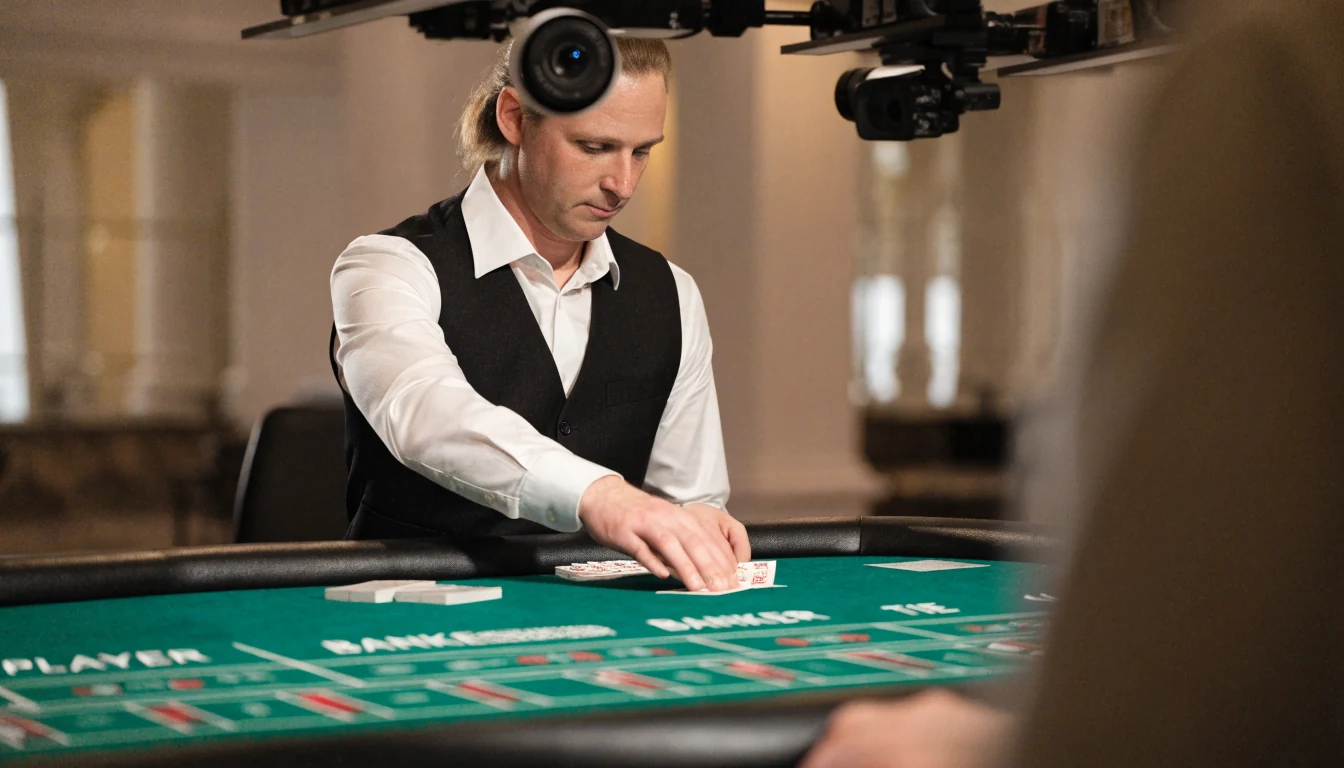
What a Live Baccarat Table Actually Puts on Screen
The clearest difference between a digital baccarat game and a live dealer table is what the image represents. In a digital game, the cards and their movement are generated on screen by software. In live baccarat, the central action is filmed: real cards are handled in a studio, and the player sees a live video feed rather than only a software-rendered table.
That distinction can sound cosmetic until the table is viewed as a broadcast. The screen is not simply illustrating a game that has already been decided by a digital process. It shows a physical setup and a professional dealer working within it. The software still provides the online interface, but the dealer, cards and studio are part of the live presentation.
I find it useful to separate those layers. The video is the view into the physical table; the online interface is how the game is presented and accessed on a device. Calling the whole thing “live” refers to the dealer-led, streamed experience, not to every graphic or control on the screen being physical. A digital element and a real table can appear together without being the same thing.
Choosing a live baccarat site in New Zealand means checking which details are actually available before you play. This reference card highlights the licensing or payout information provided for each operator.
-
7Bit Casino
- License
- Tobique Gaming Commission, licence no. 0000091
7Bit Casino is listed with a licence from the Tobique Gaming Commission, licence no. 0000091.
-
N1 Casino
- License
- Malta Gaming Authority, licence no. MGA/B2C/394/2017
N1 Casino is listed with a Malta Gaming Authority licence, licence no. MGA/B2C/394/2017.
-
Lamabet
- Payout speed
- 1-3 business days
Lamabet is listed with a payout speed of 1–3 business days.
-
Zotabet
- License
- 07017519840
- Payout speed
- 1-3 business days
Zotabet is listed with licence no. 07017519840 and a payout speed of 1–3 business days.
-
Play Grand
- License
- Malta Gaming Authority, licence no. MGA/B2C/370/2017
Play Grand is listed with a Malta Gaming Authority licence, licence no. MGA/B2C/370/2017.
-
Ricky Casino
- License
- Tobique Gaming Commission, licence no. 0000002
Ricky Casino is listed with a licence from the Tobique Gaming Commission, licence no. 0000002.
-
BitStarz
- License
- Curaçao Gaming Authority, licence no. OGL/2024/165/0185
BitStarz is listed with a Curaçao Gaming Authority licence, no. OGL/2024/165/0185.
-
Neospin
- License
- Tobique Gaming Commission, licence no. 0000064
Neospin is listed with a licence from the Tobique Gaming Commission, licence no. 0000064.
-
Wintino
- Payout speed
- 1-3 business days
Wintino is listed with a payout speed of 1–3 business days.
The table is physical; the viewing is remote
A live baccarat table is filmed from a professional studio or a casino setting. The stream carries that scene to the player, who watches remotely. Real cards are used, rather than card images created solely as part of a digital table game.
This matters because the visual evidence is different. A digital game gives a designed representation of play. A live stream shows a dealer and physical equipment in a filmed environment. The camera does not put the viewer at the table, of course; it provides a view selected for the broadcast. But the underlying table is real, and the action is presented as it happens through video.
The same broad live-dealer format can include other equipment, such as real wheels in wheel-based games. Baccarat is distinguished by its cards, but the production principle is shared: physical equipment, a professional studio and a camera feed. The point is not that a live table has no software around it. It is that the game’s visible centre is not a complete digital simulation.

There is a practical limit to what the image can communicate. A camera gives a particular view, not an all-sides view of the room. The studio setting is visible only through the broadcast. So “real” should not be read as “unmediated”: the table is physical, while the player’s experience is still framed by the video and the online interface.
The dealer is part of the experience
The dealer is not a voice added over an animation. A professional dealer is present in the filmed environment, and the live feed lets the player interact with that dealer. That human presence changes the character of the screen. Instead of watching a sequence of graphics, the player is watching a person operate at a real table and communicate through the broadcast.
Interaction does not mean being physically at the table. The player remains remote, using the online service while the dealer appears on screen. The feed supplies the shared point of contact: the dealer can be seen, and interaction takes place through the live-dealer format. The table is therefore both a game environment and a broadcast environment.
That distinction is often blurred by the word “live.” In advertising, it can sound like a promise about immediacy or intimacy. In practical terms, it describes a streamed table with a professional dealer and real equipment, made available for remote play. It does not turn a screen into a seat at the studio. Still, the human element is substantive: the dealer is part of the game’s presentation, not a decorative character in a digital animation.
What “online” adds
Online baccarat can refer to more than one format. A software-based table game presents the game digitally; a live-dealer version combines an online interface with a real table shown by video. Both can be played on a screen, but the image has a different source. One is generated as a digital game display; the other carries a camera view of a dealer and physical cards.
That is the useful distinction behind phrases such as live baccarat online or baccarat at a live dealer casino. They describe the same broad format: baccarat delivered online while a real dealer works at a filmed table. For Kiwi players, “live baccarat” means a remote viewing and interaction experience, not a local physical casino visit.
When assessing what is actually on screen, I would look past labels such as “immersive” or “authentic.” Those are promotional descriptions. The concrete feature is simpler: a video feed shows professional dealers using real equipment in a studio or casino setting, with the player interacting through the online service. The rest of the interface supports that experience, but it does not change what the camera is showing.
The result sits between a conventional digital game and an in-person table. It is online in how it is accessed, physical in the equipment being filmed, and human in the dealer’s presence. That is the format. Not a simulation alone.
The Dealer, the Studio and the Pace of a Live Round
A live baccarat table has two clocks running at once. One belongs to the game: the dealer carries the round forward in a sequence that other people can see. The other belongs to the stream: the picture and sound must reach each player while the table continues to operate. That combination is what gives online baccarat with a live dealer its particular rhythm. It is not simply a digital game with a human face placed over it.

The broadcast comes from a studio or a casino based in a country. The dealer works at the physical table while the game is transmitted live, so the action is shared in real time rather than generated separately on each screen. From the operator’s side, that means coordinating a real table and a digital presentation. From the player’s side, it means following a round that advances through the dealer’s actions, not pressing a button to make an instant software outcome appear.
The distinction matters most in the gaps between actions. A software game can move from one result to the next without waiting for a person to complete a visible task. A live dealer game cannot. The dealer has to conduct the round, while the broadcast makes those actions observable. Even when little seems to be happening, the table has not necessarily stopped; it may simply be at a point where the next step depends on the dealer or on the game’s turn-taking sequence.
That creates a pace which can feel deliberate, but not necessarily slow. Most live games give players a limited period to place a bet. The table then moves on, rather than leaving the decision open indefinitely. In practice, the countdown is part of the design: it keeps the round moving and allows the dealer to proceed on a shared schedule. The same timing can make a live table feel brisk when the window is short, even though each round contains more visible transitions than a game run entirely by software.
There is a trade-off. The schedule keeps a table from waiting endlessly for decisions, but it also means the experience is less self-paced. A player joining mid-session enters a rhythm already in progress. The table opens a betting phase, closes it, and advances through the round; there is no expectation that the broadcast will pause while one person studies the screen. That is a basic operating condition, not a defect. The dealer is managing one table for everyone watching.
This is also why a live dealer baccarat table may feel different from a private, single-player digital game even when both present the same broad game choice. The digital version can compress transitions into a short sequence on screen. The live version exposes more of the process around the round. The camera view, dealer and table make the action legible, but they also make its timing part of the product. “Live” describes the delivery, not a promise that every moment will be instantaneous.
The broadcast itself adds another dependency. A studio table has to be presented through a working video connection, and the game interface has to remain aligned with what is being shown. A specialist review of live dealer play reports that technical problems can occur from time to time. That is a report about the format, not a forecast that a particular table will fail. If the video stalls or the interface appears out of step, the sensible response is to distinguish a temporary interruption from the normal pauses built into a round. A dealer waiting for a phase to finish is not the same thing as a stream that has stopped updating.

Operators and studios have a practical reason to make those states clear. The broadcast is not just atmosphere; it is how the round is communicated. If the picture is interrupted, a player may not be able to tell whether the table is waiting, moving forward or reconnecting. The details of handling a disruption can vary by platform, so no single recovery procedure applies everywhere. What can be said generally is narrower: a live table depends on the feed and the interface functioning together, and occasional technical trouble is possible.
From the inside, the most useful way to read the pace is to separate deliberate waiting from failed transmission. The first is built into turn-taking. The second is an operational interruption. Confusing the two makes an ordinary pause look like a malfunction, or a genuine loss of connection look like part of the show. Neither helps.
A live dealer baccarat session therefore runs on people, a scheduled round and a broadcast that carries the action to remote screens. Software still supports the online experience, but it does not remove the human sequence that defines the table. The pace is shared. The feed has to keep up.
Banker, Player or Draw: How Baccarat Bets Work
Baccarat centres on a comparison between two hands: the player hand and the banker hand. The aim is to predict which will finish with the higher value. The hand closest to nine wins, so a live baccarat wager is a forecast of the result rather than a decision about how either hand should be played.
The names can be misleading. “Player” does not mean the person placing the wager, and “banker” does not mean the casino employee dealing the cards. They identify the two sides in the game. A Kiwi player watching baccarat live online is choosing which side to back, while the two baccarat hands determine the outcome.
Player Hand
A wager predicting that the player hand will finish with a value closer to nine than the banker hand.
Banker Hand
A wager predicting that the banker hand will finish closer to nine than the player hand.
Draw
A prediction that neither the banker nor the player hand will win the comparison.
There are three possible results: the player hand wins, the banker hand wins, or the hands draw. That distinction matters because a wager is not the same thing as an outcome. The wager names the result being predicted; the game then produces one of the available results. A draw is therefore not a third hand or a separate player. It is a result in which neither side wins the comparison.
What the wager is asking
For a player bet, the prediction is that the player hand will finish closer to nine than the banker hand. For a banker bet, the prediction is reversed. The aim is not to guess which hand has a particular card, nor to influence the cards dealt. It is simply to identify the side with the higher final hand value.
That makes baccarat unusually direct to describe. The game’s central question is comparative: which hand is nearer to nine? The cards matter because they determine the hand values, but the bettor’s choice remains between the two named sides. The draw sits alongside those wins as a possible result, which is why it should not be treated as if every round must produce a banker or player victory.
In practice, the terms can blur together when a table interface presents bets and results in the same visual space. I have found it useful to keep the two ideas separate: a selection is the prediction entered before the result, while banker win, player win, or draw describes what happened. That distinction makes the settlement easier to understand, particularly when the result does not match either side backed.

A live baccarat online game does not change that basic structure. The dealer and cards provide the visible setting, but the wager still concerns the comparison between the banker and player hands. The broadcast does not turn the bet into a choice over the dealer’s actions. The player is predicting an outcome, not taking part in deciding how the hands are played.
Banker and player are not identical bets
The two main bets may look symmetrical: one backs the banker, the other backs the player. Their mathematical terms are not quite the same, however. The house edge for live dealer baccarat is around 1.06% on a banker bet and around 1.24% on a player bet. Those figures show a modest difference in the game’s built-in advantage, with the banker wager carrying the lower edge.
That comparison is useful, but it should not be mistaken for a promise about an individual round. The house edge describes the mathematical position of a bet over play; it does not predict which hand will win next. A lower edge does not make a banker result certain, and the player side remains a valid outcome rather than a mistake in the rules.
The figures also do not alter the goal of the game. Both bets are still based on which hand comes closest to nine. The difference is in the mathematical cost attached to backing each side, not in a different way of judging the hands. I keep those questions apart: first, what result is being predicted; second, what the stated edge says about the wager over time.
Do
- Compare the house edge of different bets
- Distinguish the wager from the outcome
Don't
- Mistake a low house edge for a guaranteed win
- Assume a lower edge makes a result certain
The draw deserves separate attention because it can interrupt the simple banker-versus-player framing. It is one of the game’s possible results, even though the two principal predictions concern the banker and player hands. The key point is not to assume that a round must produce a winning side. A draw is part of the outcome set, and the exact way a particular wager is settled depends on the rules displayed for that table.
That is the working model for live baccarat: compare the two hands, identify which is closer to nine, and distinguish the wager from the result. Banker and player bets make opposing predictions; a draw remains possible. The edge figures add a further difference between the two main choices, but the underlying question stays the same. Which hand finishes nearer to nine?
Bitcoin and Other Ways to Move Money
A live baccarat deposit is a separate transaction from a bet. The account balance has to be funded first, and the available route depends on what the operator supports. For Kiwi players, the currency question matters as much as the payment logo: many operators accept deposits and withdrawals in New Zealand dollars, but that does not mean every cashier offers NZD for every method.
When an account and payment method both support NZD, the displayed balance can stay in that currency. If they do not match, a conversion may enter the process. That can affect the amount credited or returned, even when the payment itself goes through. The practical detail is in the cashier’s stated currency and any conversion terms, not in the fact that a site accepts a familiar payment brand.

Bitcoin is one route used for online baccarat accounts. A deposit made in Bitcoin is not the same as a NZD deposit: the transaction is denominated in cryptocurrency, and the account may handle conversion separately. The cashier’s instructions determine what address or payment step is required and which currency the balance will show. A bitcoin live baccarat search may lead to a cashier that supports the coin, but the game itself does not establish that payment option. It is an account feature.
A specialist review reports that crypto payouts can clear in under an hour, while POLi and e-wallet withdrawals are listed at 24 to 48 hours, and bank transfers at 5 to 7 business days. Those are figures reported by that type of source, not a guaranteed schedule across operators. Processing may depend on the operator’s procedures and the payment route selected. The withdrawal estimate should therefore be read as a stated or reported timeframe, not as a promise that a particular transfer will arrive by then.
The same distinction applies to payment-method claims. A specialist review describes Neteller, Skrill and Bitcoin as options for fast deposits or withdrawals, while noting that restrictions or fees may apply. Availability is operator-specific. A method shown on a general payment page may not necessarily be offered for both deposits and withdrawals, or for every currency. The cashier’s terms matter more than a logo in a promotional panel.
For an account used to place a live bet on baccarat, the balance is the bridge between the payment system and the table. Deposits, bets and withdrawals are distinct stages; a successful deposit does not settle the terms for taking money out. The operator may set different supported methods at each stage, so the withdrawal route should be checked separately. This is where apparent convenience can narrow. A deposit option may be easy to use, while the available withdrawal choices or processing estimate may differ.
Payment details also change over time. An operator can alter its supported currencies, payment partners or conditions, and a third-party review may not reflect the current cashier. This is particularly relevant for Bitcoin, Neteller and Skrill, where a method’s presence does not by itself establish that it is available to every account or transaction. A live baccarat online Bitcoin option is only useful when the operator’s own payment terms confirm the route, the currency and any conditions attached to it.
I have seen payment pages make the deposit side look simple and leave the withdrawal mechanics in smaller print. That is not a technicality. It is the point at which the choice of payment method becomes real.
Why Free Live Baccarat Is Rare
A free-play version of live baccarat sounds like a simple way to try the table without staking money. The difficulty is that the dealer and broadcast do not become cost-free when the player’s balance is set to zero. A live table still has to be run, and that operating expense is why casinos typically do not make live dealer games available as unrestricted free play.

The cost sits behind the screen. A live dealer table requires professional staff and a studio capable of transmitting the game. Those are ongoing operating requirements, not features that can be switched off for a demo session. The video feed may look like a single table, but providing that experience takes more than displaying a result on a screen.
That changes the economics of a free version. A digital game can present play without having a dealer conduct each round on camera; a live table depends on the live operation itself. Making that experience available without wagering would still leave the casino carrying the costs of the table. From the operator’s side, the question is not just whether a free mode can be added to the interface. It is whether the live service can be funded when the session brings in no play revenue.
This is why “free” can be a misleading label in this context. It may describe a trial mode for some casino games, but it does not mean every format can be offered on the same terms. With live baccarat, the service has real staff and production behind it. There is a bill before the first hand.
The distinction also explains why a free-play option should not be assumed just because a site offers other games in demo mode. A casino may be able to provide a no-stake version of a digital game while keeping its live dealer tables for real-money play. The two formats have different operating demands. A demo button is not proof that the live table is available without a wager.
Why is free live baccarat rare?
Live dealer tables require professional staff and studio production, creating ongoing operating expenses that casinos typically do not cover for unrestricted free play.
For anyone looking to play baccarat online live free, the realistic expectation is limited: live dealer games are generally not offered as free play because running them costs casinos money. That does not make every free trial impossible, but it does mean that availability should be checked for the specific table rather than inferred from the site’s other games.
The same cost explanation applies whether the table is described as live baccarat online free or as a free-play option. Changing the label does not remove the dealer or studio expense. The live service has to be paid for somehow. That is the commercial constraint.
Playing Live Baccarat When the Table Is Moving
Live baccarat asks for decisions within the rhythm of a shared table, rather than whenever a player happens to be ready. Some versions impose specific time limits for making a play. That constraint changes the experience: attention has to stay on the current round, and choices cannot always be postponed while the table continues.
From the operator’s side, a timed decision window serves a practical purpose. A live game involves several participants and a dealer working through a common sequence; leaving one person’s choice open indefinitely would hold up everyone else. The limit keeps the table moving. It is a feature of the format, not evidence that a player needs to act quickly to improve the outcome.
The useful adjustment is made before the decision window opens. Know which action is intended, check that the interface reflects it, and avoid treating the last moments as time to reconsider every possibility. When a choice is made under pressure, a misclick or an unfinished selection is more likely to come from divided attention than from a complicated game. Simple preparation helps: keep the table visible, reduce distractions, and make sure the controls are understood before joining a round.
The exact timing is not necessarily identical across live baccarat games. A player cannot assume that every table allows the same amount of time or handles an unfinished decision in the same way. The game’s own prompts and rules are the relevant guide. If the available window feels too short, watching a round before taking part can show how that table’s interface and timing work without requiring a decision in the moment.
That distinction matters for anyone looking to play live baccarat online. The speed is not only the dealer’s pace; it also comes from having to follow the table and respond within the limits set by the particular game. There is no need to imitate the fastest participant or to treat each prompt as a reason to rush. A decision made deliberately, while the window is open, is different from a decision made in panic.
I have seen the same design trade-off across live products: a table needs enough time for players to act, but not so much that the shared round stalls. The limit is part of how the game is operated. It can make a live session feel more immediate than a version played entirely at a player’s own pace, even though the underlying objective is unchanged.
For those who prefer to pause between decisions, that distinction is worth weighing before joining a live table. The live format rewards attention to the current screen and awareness of the table’s prompt. It does not reward haste for its own sake. Keep pace, but do not confuse pace with pressure.
- Understand the table's controls
- Decide on the intended action before the window opens
- Ensure the interface reflects the choice
- Reduce distractions to avoid misclicks
What the Baccarat House Edge Means in Practice
The house edge is a long-run measure of the game’s mathematical advantage to the casino. For live dealer baccarat, the stated figures are around 1.06% on banker bets and 1.24% on player bets. The gap is modest, but it is real: over a large volume of play, the banker option has the lower expected cost.
That does not mean a particular banker bet is likely to lose only a small amount, or that results will track the percentages over a short session. The figure describes the game’s underlying mathematics across repeated wagering. Individual outcomes can vary sharply, and a short run can favour either side. I have seen “low edge” used as if it meant low risk. It does not. It describes an average built into the rules, not a promise about a player’s results.
The distinction matters when comparing the two main bets in a baccarat game. A smaller edge is not a guarantee of a win, and choosing the lower-edge option does not make the table predictable. It means that, on the stated mathematical basis, less of each unit wagered is expected to be lost to the house over time than with the higher-edge option. The edge is a cost of the wager, not a fee charged separately after a hand.
For anyone assessing a live baccarat game online, the useful comparison is therefore the edge attached to the bet, not the atmosphere of the table or the pace of the feed. A professional dealer and physical cards make the game live; they do not change the significance of the odds. The figures apply to the betting options, while the video presentation is a separate feature.
A practical reading is simple: banker has the lower stated house edge, while player has the higher one. Neither figure tells what will happen next. The edge becomes informative when viewed across repeated play, where small mathematical differences matter more than they may appear in a single decision. It is a measure of expected cost, not a forecast for the next hand—and not a reason to treat a bet as safe.
Crypto Payouts: Fast Does Not Mean Cost-Free
For live dealer baccarat funded with crypto, the headline is often speed. A specialist review reports that crypto payouts can clear in under an hour, compared with 24 to 48 hours for e-wallets such as Neteller and Skrill, and 5 to 7 business days for bank transfers. Those are reported timings, not a service standard: the payment route, operator processing and any account checks can affect when funds arrive.
Bitcoin is the crypto method named in specialist reviews alongside Neteller and Skrill. The same reviews describe these options as supporting fast deposits or withdrawals, but also note that fees or restrictions may apply. “Fast” describes one part of the transaction, not necessarily the full cost or the amount available to move.
I have seen payment wording blur that distinction. A site may describe a withdrawal as quick while setting conditions around which method can be used, or whether the method used to deposit must also be used to withdraw. The specific terms matter more than the label attached to the cashier option. A crypto route may suit one account and be unavailable to another.
The amount received can also differ from the amount requested if fees apply. With Bitcoin, there may be costs associated with moving funds, while an operator may impose its own payment conditions. These are separate questions from how quickly a payout is processed.
The practical comparison is therefore not simply crypto against bank transfer. It is the stated processing time, any applicable charges, and the operator’s restrictions on that payment method. A short quoted wait does not settle the rest. Speed is only one line.
Checking a Live Baccarat Site’s Regulatory Status
Kiwi players can access live dealer games at offshore gambling sites; New Zealand does not prohibit that access. The important distinction is that an offshore site’s availability does not mean it holds a New Zealand licence. New Zealand currently has no domestic licensing framework for online casinos, so there is no Kiwi-specific gambling licence to look for.

I treat the operator’s stated regulator as a claim to verify, not as proof. A logo or licence number on a site is only the starting point. Check whether the named body is a recognised gambling regulator, then look for the operator in that regulator’s own records. The name on the licence should match the company running the site. If the details do not line up, the badge tells little.
The Department of Internal Affairs is another point of reference: its information can help confirm an operator’s licence status. That check matters because an offshore licence and New Zealand oversight are not the same thing. Before the new domestic system, offshore online casino gambling was not licensed or supervised by a New Zealand regulator, and customers wagering through an offshore website had no domestic government recourse.
From the other side of the counter, I learned not to read “regulated” as “regulated here”. It may describe oversight in another jurisdiction, while leaving the local position unchanged. Checking both the issuing regulator and the Department of Internal Affairs helps separate those questions.
This is a status check, not a guarantee about how a site will handle a dispute or payment. Keep the distinction clear: access is permitted, but offshore access does not itself establish New Zealand regulatory approval. Short distinction.
The 2026 Licensing Change and What It Means for Live Tables
The Online Casino Gambling Act 2026 took effect on 1 May, bringing online casino gambling under a domestic licensing framework for the first time. For live baccarat, the important point is that live dealer tables are not treated as a separate class of gambling business: they sit within the same online casino category as slots and digital table games.
The new framework sets a ceiling of 15 licences across that sector. That cap applies to the operators, not to the number of tables or baccarat formats available. A live table therefore depends on the operator’s place in the licensing system, rather than on a special licence created just for streamed games.
The period between the Act taking effect and 1 December 2026 is a transition, not an instant switch to a fully operating licensed market. Online casinos already serving people in New Zealand before the Act began may continue during this window under its transitional provisions. Operators with a pending application can keep operating without advertising until the Department of Internal Affairs reaches a decision.
From 1 December, the rules narrow: only the 15 approved operators may legally accept Kiwi players under the new regulations. Providers that have not applied must stop serving the market by that date; a declined application also means leaving it. The full licensed regime is expected to be operational in 2027, so the change has stages rather than one clean overnight reset.
In practical terms, the legal category follows the service, not the screen. A baccarat table streamed from a studio is still part of online casino gambling. The licence framework catches it too.
Can New Zealand players play real-money live dealer games at offshore casino sites?
Yes. New Zealand players are not prohibited from using offshore gambling sites; choose a site regulated by a recognised gambling body and check its licence status with the Department of Internal Affairs.
Which live dealer games can New Zealand players usually access?
Live baccarat, blackjack and roulette are among the live dealer games available to players.
How many operators can hold a licence?
The Online Casino Gambling Act 2026 allows up to 15 licences for the online casino sector, including live dealer tables. From 1 December 2026, only 15 approved operators may legally accept New Zealand players under the new regulations.
Do live dealer games have a house edge?
Yes. In live baccarat, the house edge is around 1.06% on banker bets and 1.24% on player bets.
Blackjack & Live Casino in New Zealand
Content created by the «casinobonusinfonz.com» team