
Look beyond the live feed when comparing casino sites
 Available in US
See how live tables work and what to check in game rules, payment timing and bonus terms before comparing sites.
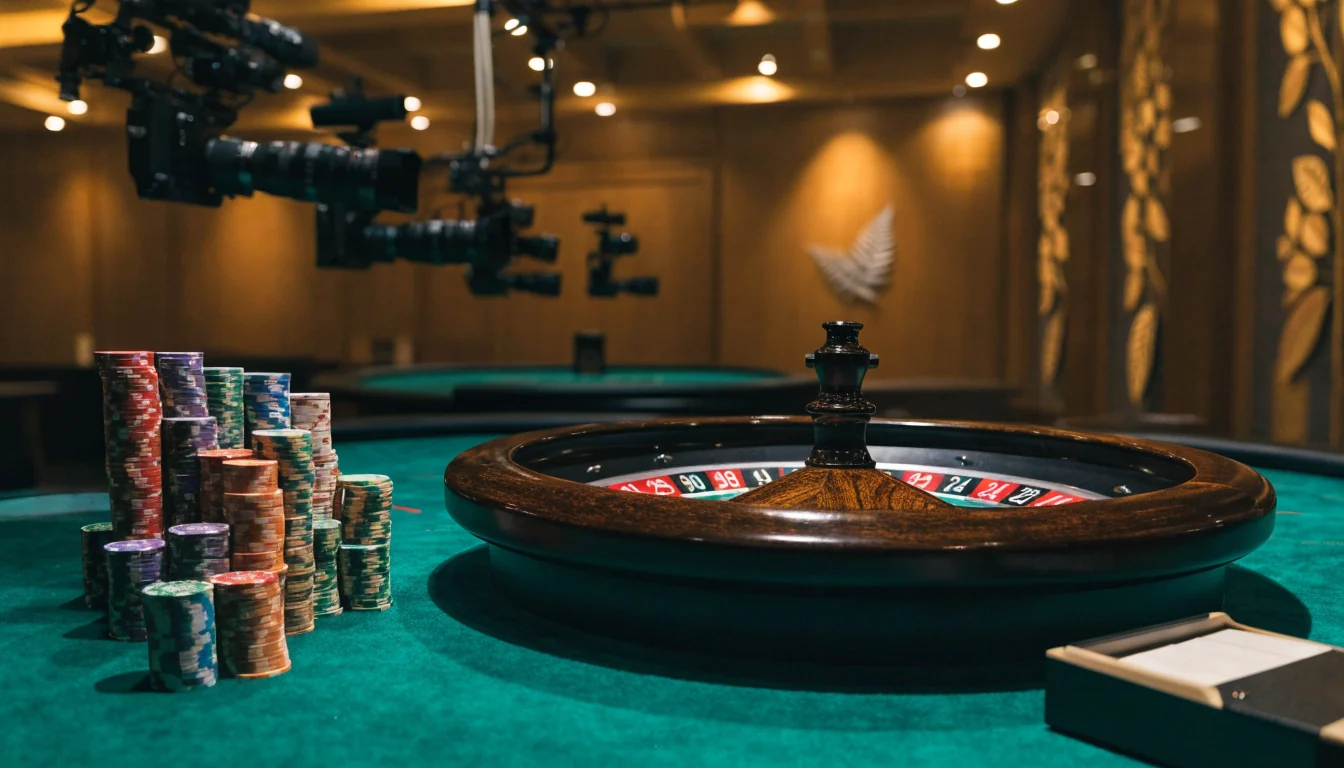
How Live Tables Work Behind the Video Feed
A live dealer casino puts a human-run game in front of a camera. Instead of seeing a table rendered entirely by software, players watch a feed from a professional studio where real cards are dealt or a physical wheel is used. The video is the visible part of a setup that joins the table’s activity to the online game.
That distinction matters. In a standard digital table game, the experience is presented through software. In a live game, the central action comes from physical equipment and a professional dealer. The studio supplies the setting; the feed carries the table to each player’s screen.
I have found it useful to separate the game itself from the way it reaches the player. A live table is not simply a digital game with a dealer’s image added for atmosphere. The cards and wheel are real, and the dealer’s actions form the play being shown. The software provides the online point of contact, while the video lets players follow the same table as it unfolds.
Choosing a live dealer casino in New Zealand is easier when you can check the available operator details before deciding where to play. Use this list as a starting point for reviewing the options.
-
7Bit Casino
- License
- Tobique Gaming Commission, licence no. 0000091
7Bit Casino lists a licence from the Tobique Gaming Commission, licence no. 0000091.
-
N1 Casino
- License
- Malta Gaming Authority, licence no. MGA/B2C/394/2017
N1 Casino lists a Malta Gaming Authority licence, no. MGA/B2C/394/2017.
-
Lamabet
- Payout speed
- 1-3 business days
Lamabet lists a payout speed of 1–3 business days.
-
Zotabet
- License
- 07017519840
- Payout speed
- 1-3 business days
Zotabet lists licence number 07017519840 and a payout speed of 1–3 business days.
-
Play Grand
- License
- Malta Gaming Authority, licence no. MGA/B2C/370/2017
Play Grand lists a Malta Gaming Authority licence, no. MGA/B2C/370/2017.
-
Ricky Casino
- License
- Tobique Gaming Commission, licence no. 0000002
Ricky Casino lists a licence from the Tobique Gaming Commission, licence no. 0000002.
-
BitStarz
- License
- Curaçao Gaming Authority, licence no. OGL/2024/165/0185
BitStarz lists a Curaçao Gaming Authority licence, no. OGL/2024/165/0185.
-
Neospin
- License
- Tobique Gaming Commission, licence no. 0000064
Neospin lists a licence from the Tobique Gaming Commission, licence no. 0000064.
-
Wintino
- Payout speed
- 1-3 business days
Wintino lists a payout speed of 1–3 business days.
Interaction is part of that format. Players can engage with professional dealers through the live feed, rather than facing only a static interface. That does not turn the session into a private conversation: the dealer is conducting a shared table, and the feed presents its activity to the online audience.
The phrase “live” can sound like a small presentation choice. It is not. It describes where the game action originates: at a physical table, captured on video, rather than solely inside a digital simulation. The distinction is straightforward, but it shapes the whole product.
There are limits to what the label tells anyone. “Live dealer” identifies a format, not a guarantee about how polished the stream is, which games a casino offers, or how a particular site handles its service. Those are separate matters. At its simplest, the format combines real cards or a real wheel, a professional studio and a live video connection that makes the table accessible online.
A camera is only the bridge.
What Makes an Online Live Table Different in Practice
The defining feature of an online live table is not simply that a dealer appears on screen. Play is broadcast in real time from a studio or a casino, while players join the same table remotely. The result has two rhythms running together: the pace of the game on screen and the pace of decisions at the table. That combination is what shapes a session.

In a digital table game, the software can move from one stage to the next without waiting for a person to deal or act. A live table has a dealer conducting play, and the stream shows that process as it happens. The online format puts the viewer at a distance from the table, but the action is still unfolding in real time. There is no pause built in merely because a player is watching through a screen.
I find the betting window is the point where this becomes most noticeable. Most live games give players a limited period to place a bet. That keeps the table moving, but it also means decisions have to fit the game’s schedule. A player may be following the dealer and the table while also keeping an eye on the moment when betting closes. Once the window has passed, the next step belongs to the game, not to anyone who has not placed a bet in time.
This gives live play a different kind of pressure from a purely digital game. It is not necessarily a question of making a complicated choice. The constraint is that the choice has to be made while the table is open for betting. The dealer’s pace, the activity on screen and the countdown to the close are all part of the same sequence. A game can feel brisk even when its individual actions are straightforward.
There is a trade-off. A limited betting period helps prevent the table from stalling while every participant decides when to act. In return, the player has less freedom to stop the flow and consider a decision at length. That is a practical feature of the format, not evidence that a particular table is better or worse. The experience depends partly on whether the live pace suits the person taking part.
The stream also makes attention part of the session. Play is not only a sequence of buttons and results; the dealer’s actions are visible as they occur. That can make the table feel more immediate than a game in which the software presents each round on demand. But “immersive” is an advertising word unless it is unpacked: what it means here is that the player follows an ongoing broadcast and acts within the table’s timing. The screen does not stop because someone is still watching.
A broadcast depends on technology, so interruptions are possible. A specialist review has reported that live dealer games can encounter technical problems. That is a reported possibility, not a guarantee that a stream will fail or a measure of how often it happens. It does explain why a live session can feel less self-contained than a game that runs entirely within software: the video feed is part of the experience, and a disruption can affect what the player sees.
When the image or connection is interrupted, the immediate issue is uncertainty about what is happening at the table. The game is designed around real-time play, so a technical pause can break the flow that the betting window establishes. The distinction matters: a slow moment caused by the normal pace of a live table is not the same as a technical problem. One is part of play; the other is a disruption to it.

The online format therefore asks for attention to both the game and its delivery. The dealer sets the visible pace, the betting window sets the decision period, and the stream carries the action to the player. None of those elements is quite the same as clicking through a digital table game at an individual pace. The appeal is the live, shared sequence; the constraint is that the sequence keeps moving.
In practice, this is less about a camera making a game look different and more about the structure of the session. The table has its own timing, and the player joins it rather than controlling it. There is a live feed to follow, a window in which to act and the possibility of a technical interruption. That is the format. No instant reset.
Live Dealer Casinos in New Zealand: The 2026 Licensing Change
For Kiwi players, the change is not that live dealer tables have suddenly become a separate kind of gambling. The important shift is who may provide online casino gambling in New Zealand, and under what domestic framework. Live tables sit inside the same licensing category as online pokies and digital table games. There is no distinct licence just for a live dealer casino.
The Online Casino Gambling Act 2026 took effect on 1 May 2026, creating New Zealand’s first domestic licensing regime for online casino gambling. Before that, online casinos based offshore could be accessed by players, but they were not licensed or supervised by a New Zealand regulator. The Gambling Act 2003 did not permit online casinos to be based in New Zealand. That left a practical divide: offshore access was possible, while local casino licensing was not.
The new Act changes the structure, rather than placing a Kiwi-specific licence on every existing offshore site. New Zealand does not have a separate national licence for live dealer games, or a Kiwi-specific gambling licence. Instead, operators seeking to serve this market fall within the country’s online casino regime. The permitted licence count is capped at 15 across the sector, with live dealer tables included alongside other online casino products.
That shared category matters. A live table is not treated as a standalone service simply because a dealer and physical equipment appear on camera. In licensing terms, it belongs to the same online casino sector as digital table games and online pokies. The product format may differ, but it does not create an extra licence slot.
What changes during the transition
The Act sets a transition from 1 May to 1 December 2026. Online casinos that were already serving people in New Zealand before the Act began may continue during that period under the transitional provisions. This is not the same as having already received a new licence. It is a temporary route while the licensing system is put into effect.
The key date for operators is 1 December 2026. From then, only 15 approved operators may legally accept New Zealand players under the new regulations. Operators that have not applied must stop serving the market by that date. A provider with an application still being considered may continue operating while awaiting a decision, but it must not advertise during that period. If an application is declined, the provider must leave the New Zealand market.

The distinction between applying and being approved is easy to blur in promotional language. They are not equivalent statuses. An application does not itself mean that the Department of Internal Affairs has granted a licence, and a transitional right to continue is not a permanent authorisation. The government’s full licensed regime is expected to be fully operational in 2027, so the change unfolds in stages rather than on one clean switch.
A fixed cap also does not mean that every operator active before the transition will receive a place. The Act permits no more than 15 licences for the sector; it does not make every previous offshore service eligible by default. For live dealer casinos, the relevant question is therefore not whether a site offers a streamed blackjack or roulette table, but whether its operator is permitted to serve the New Zealand market under the new framework.
Offshore access and local oversight
The licensing shift does not erase the history of offshore access. Kiwi players have not been prohibited from visiting international gambling sites, and the earlier absence of domestic licensing did not mean those sites were supervised by New Zealand authorities. The practical difference was that a customer using an offshore website had no domestic government recourse if a dispute arose. Access and local oversight are separate matters.
The new rules draw a clearer boundary around which providers may accept players here. During the transition, some existing services can continue under the Act’s provisions; after the transition date, legal permission depends on approval under the new regime. That is a change in the operator’s position, not a sudden reclassification of live blackjack or baccarat as games requiring their own special category.
I would read the dates as operational milestones, not as a claim that every detail of the system changes overnight. The Act is in force, the transition has a defined end, and the licensed regime is still being implemented. The distinction is material. Not a marketing label.
For a live dealer casino operating in New Zealand, the same online casino licence category applies whether its tables use real dealers or its games are digital. The sector-wide limit is 15 licences, and from 1 December 2026 only approved operators may legally accept Kiwi players. That framework is the core change: offshore access existed before, but domestic licensing and supervision did not.
Choosing a Live Dealer Site Without Relying on the Sales Pitch
A polished table, a busy lobby and a dealer addressing the camera can make a casino look established. None of those things answers the more important question: which company is actually accepting the bets, and who oversees it? I have found that the useful checks sit behind the presentation, in the operator’s legal details and the regulator’s records.
Kiwi players can access live dealer games at international or offshore gambling sites. That access should not be mistaken for local oversight. Before treating a site as a credible option, establish whether it is regulated by a recognised gambling body and whether the licence applies to the company running the casino, rather than merely to a software provider or a related brand.
Start with the operator, not the table
The company name in a footer, terms page or privacy notice may differ from the brand shown across the site. That is not automatically a problem, but it needs to be clear which legal entity holds the licence and provides the gambling service. If the site names one company in its terms and another in its licence information, the relationship should be explained rather than left to guesswork.
Then check the regulator’s own records. A logo or licence number displayed on a casino page is a claim by the operator; it is not independent confirmation. The regulator’s register, where available, can help establish whether the named entity is licensed and whether the details match what the casino publishes. A recognised regulator matters because it gives the licence a verifiable source. A badge alone does not.
This check is about accountability, not a promise of good service. Regulation does not mean that every dispute will be resolved in a player’s favour, or that every table will run without interruption. It does make a difference to the question of who is responsible for oversight and where the stated licence can be checked.
Check the New Zealand position separately
Foreign regulation and New Zealand status are separate questions. A casino may hold a licence from an overseas gambling authority; that does not make it a New Zealand-licensed casino. New Zealand players are not prohibited from accessing offshore platforms, but the absence of domestic oversight has practical consequences. In particular, a foreign licence should not be presented as if it were local approval.
Do
- Verify the operator via the Department of Internal Affairs
- Check the regulator's official register
- Match the legal entity in terms with the licence holder
Don't
- Rely solely on a licence logo or badge
- Assume a foreign licence equals local approval
- Trust marketing language over verifiable records
The Department of Internal Affairs is the place to confirm an operator’s licence status in the New Zealand context. That check is distinct from verifying an overseas regulator’s records. I treat the two as separate lines on the same page: what the foreign authority says, and what the New Zealand authority says about the operator’s status here. Neither should be inferred from the casino’s own marketing language.
Wording matters. “Licensed” can sound complete while omitting who issued the licence, which company holds it, or what activity it covers. The useful version names the regulator and the operator clearly enough for the details to be checked. If those particulars are difficult to find, that is a reason to pause, not a reason to fill in the gaps on the company’s behalf.
Read the terms as operating documents
The terms and conditions show how the site describes its relationship with customers. Check whether the legal operator named there matches the company in the licensing information, and whether the site explains its complaint process and governing rules. These details do not establish that a casino is trustworthy on their own. They reveal whether its public claims can be followed through to a named entity and a regulator.
I also separate presentation from evidence. A professional studio, fluent dealer and well-designed interface describe the product, not the operator’s regulatory standing. A casino with live dealers should be assessed on the same basic evidence as any other offshore gambling site: identifiable operator, verifiable regulation and a clear New Zealand status. The camera is not the credential.
Deposits and Withdrawals: The Timing Behind the Payment Label
A payment method’s name tells only part of the story. The deposit and withdrawal journeys are not necessarily mirror images: money can reach an account quickly while a payout follows a different route and takes longer. I learned to read “instant” as a description of one step, not a promise about the entire transaction. The useful detail is which direction the claim covers and what happens after a withdrawal request is submitted.
A specialist review gives one set of reported timings: crypto payouts may clear in under an hour, POLi and e-wallet transfers are listed at 24 to 48 hours, and bank transfers at 5 to 7 business days. Those are figures reported by that type of source, not a dependable schedule for every operator or transaction. Processing arrangements can change, and a payment label alone cannot confirm when funds will arrive.
That distinction matters most when comparing a deposit with a withdrawal. A fast deposit does not establish that a payout will be equally quick. For withdrawals, the stated timing may refer to the payment service’s part of the journey rather than the full time from request to funds received. The wording on an operator’s payment page needs to be read closely: does it describe deposits, withdrawals, or both? Does it explain when the clock starts? If the terms do not make that clear, the speed claim leaves an important gap.
Crypto Payouts
Reported to clear in under an hour.
POLi and E-wallets
Listed at 24 to 48 hours.
Bank Transfers
Estimated at 5 to 7 business days.
NZD avoids one layer of conversion
Many operators accept deposits and withdrawals in New Zealand dollars. For Kiwi players, using NZD can make the amount entering and leaving the account easier to follow because the displayed balance and the payment amount use the same currency. It also avoids treating a foreign-currency figure as though it were the amount that will appear in a local account.
That does not mean every payment route handles currency in the same way. The available currency can depend on the operator and the method selected, so the payment screen and terms matter more than a general claim about NZD support. If an account is set up in another currency, conversion may affect the amount credited or received. The relevant point is not just whether the site shows an NZD option, but whether that option applies to both deposits and withdrawals.
I treat currency display and settlement timing as separate checks. A transaction can be denominated in NZD without being fast; a quick payment route may still have conditions or costs. Confusing the two produces a neat-looking balance and an unclear final amount.
Payment labels do not show the full cost
A specialist review identifies Neteller, Skrill and Bitcoin as methods associated with fast deposits or withdrawals, while noting that limitations or fees may apply. That description is not a universal promise. Availability, restrictions and charges can differ, and the label “fast” does not explain which transaction is fast or what conditions attach to it.
Fees are easy to overlook because they may sit outside the prominent payment logo or headline. A method can appear convenient at the deposit stage yet have a restriction when used for a payout. The terms should therefore be checked for the direction of payment, any stated charges, and any limits tied to that method. These details affect the amount and timing that matter in practice.
The same care applies to crypto. A payout speed reported for crypto is not a guarantee that every request will clear within that period. The cited timing is a reported observation, not a service standard. Nor does a short settlement estimate establish that crypto suits every account: the method’s availability and any operator-specific conditions still matter.
Read the sequence, not the badge
When I compare payment information, I separate the transaction into its visible stages: submitting the request, any operator-side handling, and the payment service’s settlement. A page that gives a single time without saying which stage it covers is difficult to use as a practical estimate. The difference is not cosmetic. “Processed” and “received” can describe different moments.
The advertised speed also says nothing on its own about whether the method is supported for both directions. A deposit option may be displayed prominently, while withdrawal choices are listed elsewhere or subject to separate terms. A careful comparison records the method, the currency, whether it supports deposits and withdrawals, and the timing statement attached to each. No ranking is needed to see where the information is incomplete.
For a live dealer casino, payment mechanics sit alongside the entertainment rather than inside it. A smooth table session cannot settle a withdrawal, and a fast deposit does not answer how funds leave. The label is only the start. The terms are the substance.

Bonuses on Live Dealer Casinos: Read the Cap Before the Offer
A live dealer casino bonus can look generous in a headline while the operative limit sits in the rules around it. In New Zealand, bonus offers are capped at NZ$100 or 200% of the deposit. That ceiling matters more than promotional language: “matched” or “extra” describes the pitch, not permission to exceed the applicable cap.
The wording should be read as a condition, not decoration. A percentage-based offer and a fixed-dollar ceiling are different ways to express a limit; the promotion’s terms determine how the cap applies to that particular offer. A headline alone cannot establish the value available to an individual player, and it does not override the market rules.
I have seen promotional copy do its work before the conditions get read. The large number catches attention; the smaller qualification controls the offer. That is ordinary sales design, not evidence that a bonus is tailored to live tables or that every game contributes equally to its conditions. The distinction is easy to miss.
A live-table promotion also should not be assumed to be a separate category with a different ceiling. The cap concerns bonus offers in the New Zealand market, rather than a special allowance for live blackjack, roulette or baccarat. The presence of a dealer on screen does not change the regulatory limit.
Timing matters as well. During the transition period, online casino operators are prohibited from advertising to people in New Zealand. Advertising by licensed operators is permitted under tight rules, while sponsorships are prohibited. A promotion seen online is not, by itself, proof that it is authorised, current or available under the applicable conditions.
The useful test is therefore narrow: what does the offer actually promise, how is the cap expressed in its terms, and does the promotion comply with the rules applying in New Zealand? Without clear terms, the headline is not a reliable measure of value. No mystery.
Live Blackjack, Roulette and Baccarat: Different Rules, Different Edges
The headline “live dealer games” covers three different decisions at the table: how to build a hand, where to place a bet, and which outcome to predict. The rules set the shape of the game; the house edge describes the casino’s mathematical advantage over time. It is not a forecast of what will happen in a particular round.
In live blackjack, each player competes against the dealer. The aim is to finish with a total closer to 21 than the dealer’s hand, without going over 21. That comparison is the point: a hand does not need to beat every other player’s total. I find it useful to keep the objective separate from the pace. Live blackjack can take longer than RNG blackjack because each player and the dealer act in turn. Waiting is part of the game.
Roulette is simpler to describe, though the wheel version matters to the edge. A live European wheel has a stated house edge of about 2.7%; on an American wheel, it is about 5.26%. The difference comes from the wheel format, so the table’s label is more than decoration. Same broad wager. Different maths.
Baccarat asks players to predict whether the player or banker hand will finish closer to 9. The possible outcomes are a banker win, a player win or a draw. The stated house edge is about 1.06% on a banker bet and 1.24% on a player bet. Those figures apply to the named bets, not to baccarat as one undifferentiated choice.
The useful comparison is not “which game is easiest?” Blackjack involves decisions against the dealer and a turn-based pace; roulette ties the edge to the wheel format; baccarat puts the choice on the predicted winning hand. The percentages do not promise a result in any session. They describe the built-in mathematical terms, while the rules determine what each bet means.
Small differences matter.
The Indaxis Search: What Can—and Cannot—Be Verified
A request for a live dealer casino associated with Indaxis is not, by itself, evidence that the site operates a live table, accepts Kiwi players, or holds a gambling licence. A name and a web address are identifiers, not credentials. I have seen how quickly those get blurred in casino copy: a page can describe a service confidently without establishing who runs it or what oversight applies.
That distinction matters in New Zealand. Kiwi players can access offshore gambling sites, and playing at one is not itself prohibited. But general access says nothing about the status of a particular operator. Before the Online Casino Gambling Act 2026, offshore online casino services were not licensed or supervised by a New Zealand regulator, so customers had no domestic government recourse if a dispute arose. The new framework does not turn every site with a live dealer into an approved provider.
For Indaxis specifically, the name alone does not establish whether live dealer games are available, which company operates the service, or whether any regulator oversees it. Those details should not be filled in by inference from a search result, a promotional description, or a familiar-looking logo. “Live dealer” describes a game format; it does not certify the business behind the table.
My own rule is to separate claims from checks. An offshore site should be regulated by a recognised gambling body, and its licence status can be confirmed with the Department of Internal Affairs. A regulator’s register or official confirmation carries more weight than a site’s own wording. If the operator’s legal identity, licence details and terms do not line up, the remaining uncertainty is material.
The licensing position is also changing. The Online Casino Gambling Act 2026 took effect on 1 May 2026, with a transitional period for existing providers. From 1 December 2026, only approved operators may legally accept Kiwi players under the new regulations. That timetable is a market-wide rule, not proof of Indaxis’s status.
So the careful answer is narrow: offshore live dealer access exists in general, but the Indaxis name alone cannot establish the site’s games, operator, or regulatory standing. A clear distinction.
A Real Live Dealer Casino Is More Than a Camera Feed
A live blackjack table has two versions of the same hand to keep aligned: the physical cards on the table and the game state shown in the software. The dealer handles the cards; a barcode scanner reads markings or chips embedded in them so the software can register what has been dealt. That link is what makes the video more than a picture of a card game.
The dealer is not an animation placed over a digital table. Live dealer games are broadcast from a studio or a casino based in a particular country, with real dealers conducting play as it happens. The camera lets players follow that table in real time. But the stream alone does not tell the software which cards have entered the hand. The scanner supplies that information.
This distinction matters when judging what “real” means in a live dealer casino. The cards and dealer are physical; the online interface still has to translate events at the table into a form the game can process. In blackjack, the scanner’s role is to keep those two records in step. If the cards shown on screen and the hand recorded by the software did not correspond, the digital game state would not reflect the table.
I see this as a basic control point, not a flourish for the broadcast. A polished camera angle can make a table look convincing, but the game also depends on the physical result being recognised by the software. The dealer runs the hand; the scanner connects the dealt cards to the digital record.
That is the working distinction between a live table and a digital recreation. One presents a real table through video, while the game software follows the action through the scanner’s reading of the cards. The equipment is easy to overlook because the feed gives most of the attention to the dealer. Its function is less visible, but central to the connection.
Real cards. Digital record. The scanner bridges them.
Comparing Live Dealer Casinos Without Inventing a Top Ten
A numbered top ten would imply that the same checks had been applied to each casino and that the results support a consistent order. Without comparable evidence, that ranking would be decoration, not an assessment. The useful comparison is narrower: what can be checked, and what each check actually tells us.
Licence status is a starting point, not a quality score. An operator’s status should be confirmed with the Department of Internal Affairs; a polished website or a reference to an overseas regulator is not a substitute for that check. Nor does a licence alone establish how a live table plays or how quickly a withdrawal will arrive. Different questions need different evidence.
Game mechanics provide a more concrete basis for comparison. Live blackjack can move more slowly than RNG blackjack because the game waits for other players and for the dealer to act. That difference matters to someone comparing session pace, but it does not make one casino better than another. A claim about speed needs to be tied to the specific table and format, rather than treated as a general feature of the operator.
Payment timing is another dimension, but figures need careful handling. One specialist review reports crypto payouts clearing in under an hour, POLi and e-wallet transactions taking 24 to 48 hours, and bank transfers taking 5 to 7 business days. Those are that review’s reported timings, not a dependable promise for every operator or transaction. Processing can depend on the payment route and the operator’s handling of a withdrawal. A comparison that labels a site “fast” without stating what is being measured leaves out the useful part.
These checks do not produce a defensible league table by themselves. They help separate verifiable details from broad claims: licence status can be checked with the relevant authority, game pace can be understood from the rules and format, and payment estimates need a clearly identified source and context. No ranking can replace those distinctions. A list without them only looks precise.
Can New Zealand players play real-money live dealer games at offshore casino sites?
Yes. New Zealand players are free to play live dealer games at international or offshore gambling sites, but should check that the operator is regulated by a recognised gambling body and confirm its licence status with the Department of Internal Affairs.
What changes on 1 December 2026?
From 1 December 2026, only 15 approved operators will be legally permitted to accept New Zealand players under the new gambling regulations.
What games can I play at a live casino?
Live casino options include blackjack, roulette and baccarat. They are played with real cards or wheels and streamed from a studio or casino.
Blackjack & Live Casino in New Zealand
Content created by the «casinobonusinfonz.com» team