
Make Sense of Blackjack Before You Play on Mobile
 Available in US
Mobile play keeps the aim unchanged: get closer to 21 than the dealer without going over, while interface and game format affect the experience.
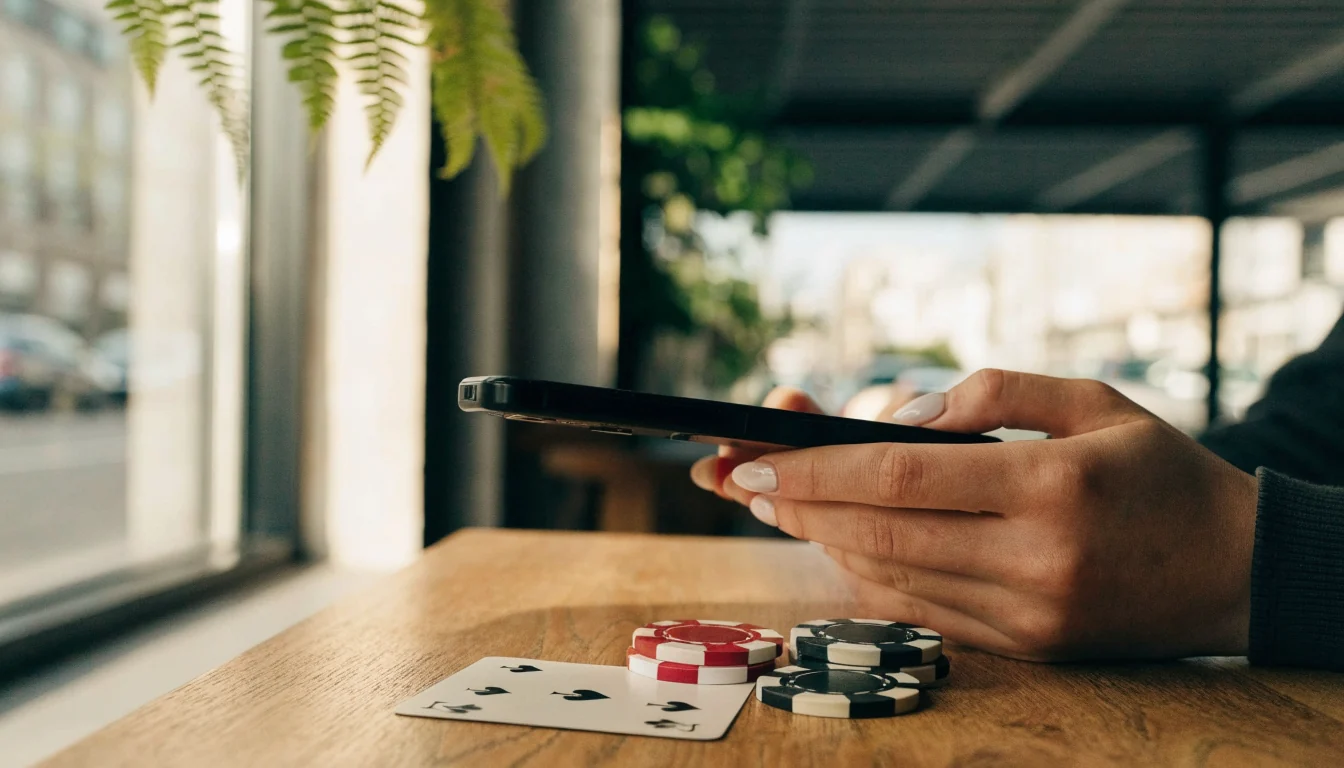
How Mobile Blackjack Works Online
Mobile blackjack keeps the basic contest simple: the player’s hand is measured against the dealer’s, and the aim is to finish nearer to 21 without going over. Number cards count at face value, picture cards count as ten, and an ace can be treated as either one or eleven. The same objective applies whether the game is opened on a phone or played at a physical table. The screen changes how the game is delivered, not what the hand is trying to achieve.
On a phone, the cards, total and available controls share a limited display. That makes legibility and pace practical concerns, not decorations. A total has to be easy to distinguish from the cards that produced it; a control has to be clear before it is tapped. I have seen how small interface choices affect a decision: if the hand value is hard to read, a player may spend more attention navigating than considering the hand. No mystery there.
An online blackjack game may use a random number generator, or RNG, to determine the cards. The software shuffles the virtual deck, and the game can move from one decision to the next without waiting for a dealer to handle physical cards. That is why RNG play can run faster than a live-dealer game. A phone does not make the shuffle more favourable or change the target; it puts the software game within reach and often shortens the pauses between hands.
Choosing a mobile blackjack site in New Zealand is easier when you can check what is actually known about each option. Use these short notes as a starting point, and verify that the site suits your needs before playing.
-
7Bit Casino
- License
- Tobique Gaming Commission, licence no. 0000091
7Bit Casino is listed with a Tobique Gaming Commission licence, number 0000091.
-
N1 Casino
- License
- Malta Gaming Authority, licence no. MGA/B2C/394/2017
N1 Casino is listed with a Malta Gaming Authority licence, number MGA/B2C/394/2017.
-
Lamabet
- Payout speed
- 1-3 business days
Lamabet has a stated payout speed of 1–3 business days.
-
Zotabet
- License
- 07017519840
- Payout speed
- 1-3 business days
Zotabet has a stated payout speed of 1–3 business days and is listed with licence number 07017519840.
-
Play Grand
- License
- Malta Gaming Authority, licence no. MGA/B2C/370/2017
Play Grand is listed with a Malta Gaming Authority licence, number MGA/B2C/370/2017.
-
Ricky Casino
- License
- Tobique Gaming Commission, licence no. 0000002
Ricky Casino is listed with a Tobique Gaming Commission licence, number 0000002.
-
BitStarz
- License
- Curaçao Gaming Authority, licence no. OGL/2024/165/0185
BitStarz is listed with a Curaçao Gaming Authority licence, number OGL/2024/165/0185.
-
Neospin
- License
- Tobique Gaming Commission, licence no. 0000064
Neospin is listed with a Tobique Gaming Commission licence, number 0000064.
-
Wintino
- Payout speed
- 1-3 business days
Wintino has a stated payout speed of 1–3 business days.
That pace has a cost as well as a convenience. When hands arrive quickly, there is less natural time between decisions. It can be easy to treat each deal as an isolated click rather than as part of a session with a real budget behind it. I would separate the speed of the interface from the quality of a decision. Faster play is not better play. Setting a budget before starting and not chasing losses are more useful safeguards than trying to keep up with the screen.
Live-dealer blackjack works differently because actual cards are dealt and the game is streamed. The stream and table activity can introduce delays, so the rhythm is less immediate than with RNG software. Those differences matter when choosing how to play, but they do not alter the central contest against the dealer. The live table experience, including its pace and trade-offs, is a separate question from the general mechanics of playing on a mobile device.
New Zealand’s regulatory setting is also part of the picture in 2026. The Online Casino Gambling Act 2026 took effect on 1 May 2026 and created the country’s first domestic licensing framework for online casino gaming. It provides a transition period through 1 December 2026: services that were already being provided to people in New Zealand before the Act began may continue during that window, subject to the Act’s transitional provisions. The full licensing system is expected to be operating in 2027.

The Department of Internal Affairs is New Zealand’s primary gambling regulator and oversees the online casino licensing framework. The Gambling Commission considers casino licence applications, decides them and issues licences; it also approves changes to licence conditions. These roles are distinct. A regulatory framework does not make every online blackjack service a locally licensed one, and the transitional arrangements are not a blanket endorsement of every site.
So the practical orientation is straightforward: mobile play is blackjack delivered through a phone, with RNG software generally allowing quicker hands than a streamed table. The game still turns on the player’s hand against the dealer’s, while the pace, interface and regulatory context shape the surrounding experience. Keep those pieces separate. A small screen is still a table.
Comparing Mobile Blackjack Games by Their Rules
A game’s appearance on a phone tells little about whether its terms suit a particular style of play. I learned to compare blackjack tables from the rule panel outward: first the hand values, then the available decisions, then the payout attached to a natural. A polished screen can make those details easy to overlook. They are the substance of the game.
The basic scoring is consistent: number cards retain their face values, face cards count as 10, and an ace can be worth 1 or 11. The player’s choices are to hit, stand, double down or split, subject to the table’s rules. The useful comparison is not simply whether those buttons appear, but what the rules permit and how each decision interacts with the hand.
- Check the payout for a natural blackjack (e.g., 3:2 vs 6:5)
- Confirm if hit, stand, double down and split are available
- Verify if decision conditions are explained clearly
- Compare the rules in free-play mode with the real-money table
Payouts deserve the same scrutiny. A natural blackjack often pays 3:2, while some tables pay 6:5; a specialist review reports that distinction, but it should not be treated as a fixed rule for every game. The ratio changes the return on a natural, so a game with familiar-looking cards may still offer materially different terms. The displayed payout is more informative than a title, theme or promotional label.
I have seen players spend time comparing graphics and then discover they had not checked the payout line. That reverses the sensible order. Read the rules before judging the presentation, and compare like with like: the same kind of hand, the same decision options and the same payout basis. If a rule is not clear on the game screen, that uncertainty is itself relevant. A feature that cannot be checked is not a sound basis for choosing a table.
Free-play versions can help with learning the controls and seeing how a hand progresses without putting money at stake. They can also make comparisons easier: the interface, card display and decision prompts are visible without the pressure of a cash wager. But free play should not be mistaken for proof that a real-money table has identical terms. The version may differ, and the rules shown in one mode do not establish the rules of another.
A practical comparison can be kept to a few questions:
- What does a natural blackjack pay?
- Are hit, stand, double down and split available under the displayed rules?
- Are the conditions for those decisions explained clearly?
- Does the free-play version show the same rules as the table being considered?
Those checks do more than sort games by convenience. Blackjack variants differ in rules, and those differences can affect strategy and the house edge. A familiar interface does not neutralise a less favourable payout or a restriction on a decision. Nor does free access make the underlying odds disappear; it changes whether money is being risked during that session.
The phrase “best mobile blackjack” is therefore too broad to settle the choice on its own. Best for learning the controls may mean a clear, usable free-play mode. Best for a cash session depends more directly on the rules and payout displayed for that specific table. Neither label substitutes for reading the terms.
I would not treat a short list of attractive features as a ranking. Without comparable rules, a ranking suggests precision it cannot deliver. Compare the actual table conditions, note any difference between practice and cash modes, and set a budget before playing for money. Chasing losses does not improve a rule set. Read the panel first. Then decide.
Can a Phone Bill Be Used to Pay for Blackjack?
A phone-bill payment sounds simple: a deposit is added to a mobile account or deducted from prepaid credit, rather than paid by card or another method. That description explains the payment idea, not whether it can be used for an online blackjack account. A game working on a phone does not establish that the casino accepts charges through a mobile network.
I learned to separate those two questions. “Mobile” describes the device or, sometimes, the payment route; it does not tell how an account is funded. Blackjack itself is played against a dealer, with the aim of finishing closer to 21 without going over. The way a deposit is handled sits outside that hand. A mobile screen can run a game even when the account’s payment options do not include phone billing.
The wording around phone payments can also blur different services. A charge placed on a phone account is not automatically the same thing as an SMS deposit, a text-message confirmation, or a one-time code used to verify an account. Those functions may sound related in a short payment label, but they do different jobs. A message that confirms an action does not, by itself, show that the amount was charged to a phone bill.
A payment page is where the distinction should become concrete. It should identify the method, explain how the transaction is processed, and set out any relevant conditions before money is committed. If the wording merely mentions mobile access or a phone number, that is not enough to establish that carrier billing is supported. Terms matter. So does the point at which a payment is actually authorised.
There is a further New Zealand context in 2026. The Online Casino Gambling Act 2026 took effect on 1 May 2026 and created a domestic licensing framework. During the transition, providers that were already serving people in New Zealand before that date may continue until 1 December 2026. The full licensed system is expected to be operating in 2027. The Department of Internal Affairs is the primary gambling regulator; the Gambling Commission handles licensing applications and licence-condition changes.

That transition does not make a particular payment method available, nor does a phone-bill label establish a provider’s status. Before the new framework, offshore online casino services were not licensed or supervised by a New Zealand regulator, and customers had no domestic government recourse when wagering with an offshore site. The law has changed, but the transition has defined boundaries. Payment convenience and regulatory position are separate checks.
The practical distinction is plain: playing blackjack on a mobile device is a matter of accessing the game; paying through a phone account is a separate service that must be expressly described in the payment terms. Neither follows automatically from the other. A deposit route should not be assumed from a mobile-friendly page, an SMS prompt, or a familiar payment phrase.
I have seen how a broad label can do more work than it should. “Pay by mobile” may sound like a confirmed billing option, while the details determine what actually happens. If those details do not say that a phone account is charged, the label is not proof. No inference from the screen alone.
American Blackjack on a Mobile Screen
“American blackjack” can sound like a fixed set of rules. On a phone, the label alone does not settle how a hand is played or paid. The practical details sit in the table rules, and they can change the decisions that make sense during a game.
Deck count is one of the details worth checking. A game may use a different number of decks from another, and the rule panel is the place to confirm what applies. The number of decks is not just decoration: blackjack variants differ in rules, and those differences can affect both strategy and the house edge.
Deck Count
Confirm the number of decks used, as this affects both the house edge and the optimal strategy.
Soft-17 Rule
Check if the dealer must hit or stand on a soft 17, which changes the dealer's play and the game's odds.
Surrender Option
Determine if surrender is available, providing an additional decision to limit losses on a poor hand.
The soft-17 rule is another point that can be easy to miss on a small screen. A soft hand contains an ace counted as eleven; a soft 17 is therefore a hand whose total depends on that flexible ace. The dealer may be required to hit or to stand on soft 17, depending on the game. That choice changes the dealer’s play, so it belongs in the rules check rather than being treated as a minor interface detail.
Surrender is similarly rule-dependent. Where it is offered, it gives a player an additional decision; where it is not, the available choices are narrower. A mobile layout may put these options behind a button or menu, but their presence should be established from the rules before play, not inferred from the screen design.
Payout language needs the same care. A natural blackjack is not necessarily paid the same way at every table. A specialist review has described a 3:2 payout at some tables and a 6:5 payout at others; that is a report about specific games, not a dependable rule for every mobile table. The difference matters because it changes the return on a natural hand. Check the stated payout for the particular game.
On a phone, compact menus can make a table appear simpler than it is. I have found that the consequential terms are often in a rules panel rather than beside the main controls. Before treating a game as American blackjack, confirm the deck count, the dealer’s soft-17 rule, whether surrender is available, and the natural-blackjack payout. If one of those points is unclear, the label does not fill the gap.

These rules also shape how decisions should be judged. A strategy built around one table’s conditions may not fit another table with different dealer or surrender rules. That is why “American” is a starting description, not a guarantee of identical play across mobile games.
Small screen. Material differences.
Live Blackjack on Mobile: Cards, Streaming and Pace
Live-dealer blackjack changes the feel of a hand because the cards are real, not generated by a software shuffle. A dealer handles them at a physical table while the action is streamed to the phone. The result resembles a casino table more closely than a software-only game, but a small screen and a network connection become part of the experience.
The distinction matters in practice. With a live stream, the image and the table’s action have to reach the device before the hand can move on. A delay can make play feel less immediate, even when the dealer is ready to continue. I have found that this is not just a matter of waiting: the player is following a shared table, rather than setting the pace hand by hand. The stream sets the rhythm.
On a phone, the display also has less room for the table than a full-size screen. Cards, dealer actions and the controls for decisions must fit into that view. Live blackjack is therefore not simply the same table reduced in size. The player has to keep track of the stream while using the controls, and a connection interruption can make the sequence harder to follow. The format trades some directness for the presence of a human dealer and physical cards.
That presence can be appealing, but it does not make the game faster or more predictable. The dealer’s actions are visible; the stream can still lag. The pace is shared, and a momentary delay belongs to the delivery of the game rather than to the cards themselves. A polished broadcast is still a broadcast.
The financial trade-off is worth noticing before joining a table. Live-dealer games may require higher bets than other blackjack options. That can make a table less suitable for a cautious session, regardless of how familiar the rules look. A live presentation is not a promise of better value. The actual table conditions matter, and a minimum stake can shape how long a budget lasts.
I treat the format as a choice about experience, not an upgrade. Real cards may feel more tangible than software play, while streaming introduces dependence on the connection and the dealer’s pace. A phone is convenient for watching from elsewhere, but it does not remove those constraints. The camera can show the table; it cannot make the stream instantaneous.
The practical test is whether the live rhythm and the table’s required stake fit the intended session. If either feels uncomfortable, the visual realism is beside the point. In blackjack, the dealer is still the opponent, and live production changes how the hand is delivered—not what the hand is. Real cards. Shared pace.
What “Unblocked” Mobile Blackjack Can—and Cannot—Mean
“Unblocked” is a label, not a legal status. It may describe a page that loads on a phone or a game that a network filter does not stop. Neither tells much about who operates the service, whether the game is actually available to a particular player, or what rules apply to that provider in New Zealand.
The legal setting is changing. The Online Casino Gambling Act 2026 took effect on 1 May 2026 and created New Zealand’s first domestic licensing framework for online casino gambling. During the transition, providers that were already serving people in New Zealand before that date may continue until 1 December 2026. The complete licensing system is expected to be operating in 2027. So a site being accessible during this period does not, by itself, show that it holds a New Zealand licence. Access and licensing are different questions.
That distinction matters because “unblocked” can sound like an endorsement. It is not. The word does not confirm that a blackjack table is offered, that its terms are clear, or that an operator has a particular regulatory status. Before the new framework, offshore online casino gambling was not licensed or supervised by a New Zealand regulator, leaving customers without domestic government recourse. The current transition does not turn a search label into a regulator’s approval.
On the table, blackjack remains a contest against the dealer: the aim is to finish nearer to 21 without going over. Card counting is a separate activity. It means keeping a running mental estimate of the cards already dealt, rather than merely choosing whether to hit or stand. Under New Zealand law, doing that mental arithmetic is not illegal. That point is narrow: it does not establish that a casino permits every method of play, that counting will work in a particular format, or that it will produce an advantage.
I have seen promotional language blur those boundaries. “Unblocked” can mean only that a page opens; “available” can mean only that a lobby appears. Neither word settles the legal or practical details. A mental count is no magic switch, either. The dealer’s cards, the rules of the game and the way cards are dealt all shape what a player can infer. Counting should not be treated as a reliable way to win.
The sensible reading is plain: confirm what the site offers and how its status fits the rules in force, rather than relying on an access label. Keep the game itself separate from any claim about counting. A page loading on a mobile screen proves just one thing. It loaded.
Blackjack Codes and Playing from Home
A code is not a move in blackjack. It is separate from the decisions made once a hand begins, and its meaning depends on the service presenting it. A phrase about mobile blackjack codes does not, by itself, establish that a working code exists or that it affects the game. I keep those two matters apart: an entry field belongs to an operator’s process; hitting or standing belongs to the table.
At home, the phone changes the setting, not the object of the hand. The player is still trying to finish closer to 21 than the dealer without going over. Number cards count at face value, face cards count as 10, and an ace can count as either 1 or 11. That flexible ace is why a hand’s total may be described as soft: the ace can still take the lower value if counting it as 11 would push the total too high.
The decisions are straightforward to name, but their consequences depend on the cards and table rules. Hitting takes another card. Standing ends the player’s turn. Doubling down increases the stake in exchange for taking a card under the table’s conditions. Splitting separates a pair into two hands when the rules permit it. Some tables also allow surrender, which ends the hand under a specified rule. The available action buttons should be read in context; a familiar label does not mean every table handles the choice identically.
On a small screen, the practical task is to distinguish the player’s cards, the dealer’s visible card and the available actions before selecting one. I have seen how quickly a decision becomes mechanical once a button is tapped, even when the reason for tapping it was never clear. A rushed hit can turn a manageable hand into a bust. A double is not simply a stronger hit; it commits more of the stake to the hand. Splitting creates separate decisions, not an automatic improvement.
That is the part worth understanding before play starts. A mobile interface may put each action within easy reach, but it cannot make the underlying choice safer or more suitable. I would not treat a code, a shortcut or a routine as a substitute for knowing what the action does. No magic button.
Do
- Pause to read the total and the dealer's exposed card
- Set a spending budget before starting
- Understand what each action (hit, stand, double, split) commits
Don't
- Chase losses to recover a previous hand
- Treat a promotional code as a substitute for game knowledge
- Make decisions mechanically without considering the table rules
A useful home routine is to pause long enough to read the total and the dealer’s exposed card, then consider the action permitted by the table. It is also sensible to set a spending budget beforehand and not chase losses. Those habits do not change the odds or guarantee a result; they simply make it less likely that a quick sequence of taps becomes an unplanned decision.
Playing the Dealer for Real Money—or Practising First
Blackjack is a contest against the dealer, not a race to make the largest total. The aim is to finish nearer to 21 than the dealer without going over. On a phone, the same decision-making applies whether the hand is played for real money or used as practice; what changes is the consequence attached to each decision.
A hand is built through choices. Hitting takes another card, while standing ends the player’s turn with the current total. Doubling down commits to a larger wager in return for taking a further card under the table’s rules. Splitting separates a pair into two hands, each played on its own. Some tables also allow surrender, which ends the hand under a rule-defined loss. The menu is not identical everywhere, so the available options need to be checked before play begins.
I have seen a common mistake in how these choices are treated: a player remembers what worked in one hand and turns it into a rule for every hand. That is not a strategy. Each decision depends on the hand, the dealer’s position and the rules at the table. A practice setting can make it easier to pause and consider those factors, but it cannot make a decision correct simply because it is made without money at stake.
A mobile blackjack trainer, where available, is best understood as a place to rehearse the sequence of decisions rather than as proof of future results. Practice can help make the options familiar and expose habits such as hitting automatically or standing simply to avoid uncertainty. It cannot reproduce the pressure of risking a real balance, and a favourable practice session does not show what a later session will produce. Training is rehearsal. Nothing more.
Real-money play changes the weight of an error. A stand, hit, double or split can affect the balance, so the decision should not be made just to recover an earlier loss or keep a session going. I would set a budget before play and treat it as a firm boundary; increasing it after a losing hand turns one decision into a chain of decisions made under pressure. Chasing losses is a poor substitute for a plan.
The phrase “play like a pro” often makes ordinary decisions sound like a shortcut. In practice, the useful discipline is less glamorous: know what the table permits, understand what each action commits, and stop when the planned budget is used. No system removes uncertainty. No hand owes a result.
For anyone weighing practice against wagering, the distinction is plain. Practice lets the player learn the controls and think through choices without risking a real-money stake. Real-money play adds financial consequences, not a guarantee that better-rehearsed decisions will win. That is the line.
Free Blackjack and Bonus Conditions
Free play and a casino bonus can look similar on a phone screen, but they are not the same arrangement. Free blackjack means playing without staking real money, where that option is provided. A bonus is tied to real-money play or an account offer and comes with conditions. It should not be treated as cash that can be withdrawn without restriction.
Understanding Bonus Conditions
Bonuses are not the same as free play; they often carry wagering requirements, maximum bet limits, and specific game contribution rates that must be met before winnings can be withdrawn.
The label “free” can obscure what is being offered. A practice mode may let a player follow a hand without placing a cash stake; a bonus may instead require qualifying play before funds or winnings can be withdrawn. Those are different purposes. The first is for trying the game; the second is a promotion with rules attached. Neither proves that a particular casino provides the feature.
The fine print matters more than the headline. I check how blackjack contributes to wagering requirements, whether a maximum bet applies while those requirements are active, and which funds or winnings are subject to the conditions. A low contribution from blackjack can make a bonus less useful to someone planning to play blackjack. A maximum-bet rule can also affect whether play complies with the offer. The wording decides. Not the banner.
Game rules matter as well. A natural blackjack payout can differ between tables, so the displayed rules should be checked before a real-money hand is played. A bonus does not improve the underlying terms of a game, and it does not remove the possibility of losing a stake.
Offer conditions can change, so the terms should be checked on trustworthy casino or information sites before real-money play. If a condition is unclear, treating the bonus as spendable cash is a poor assumption. Free play is not a reason to move into paid play, and a bonus is not a way to make gambling risk-free.
For real-money sessions, a budget set in advance gives the play a boundary. Once it is reached, chasing losses can turn a limited decision into a larger one. I have seen the distinction get lost when promotional wording leads the conversation. Keep it simple: practice is practice; bonus funds have strings.
No-Deposit Bonuses and SMS Deposits: Check the Terms
A no-deposit bonus and an SMS deposit are separate claims. The first concerns whether play credit is offered without an initial payment; the second concerns how a payment might be charged. Neither label, by itself, confirms that a particular offer or payment route is available for mobile blackjack in New Zealand.
The wording matters. A bonus described as “free” may still carry conditions before any resulting balance can be withdrawn. The terms should state which games count, how blackjack contributes towards wagering requirements, and whether a maximum-bet rule applies while those requirements are being met. If the offer page does not explain these points clearly, the headline is not enough to assess its value. No free ride.
SMS payment needs a different check. The payment terms should identify how the charge is made, what confirmation is provided, and how a disputed or failed transaction is handled. A phone number appearing in a payment flow is not, on its own, proof that the amount will be charged to a mobile bill; nor does it establish that the method can fund casino play. Keep the payment conditions separate from the bonus conditions.
New Zealand’s regulatory position is also changing. The Online Casino Gambling Act 2026 took effect on 1 May 2026 and created a transition period ending on 1 December 2026. During that period, providers that were already serving New Zealand customers before the Act began may continue operating under its transitional provisions. The full domestic licensing system is expected to be operational in 2027. An offer’s appearance on a mobile site does not explain its regulatory status or the protections attached to a transaction.
I would treat the offer page, payment screen and terms as three parts of one decision, not as interchangeable assurances. Check that the stated bonus conditions match the displayed offer, and that the payment method is explicitly described before authorising a charge. Set a budget for any real-money play and do not chase losses to meet an offer condition. If the terms leave the essential details unclear, the sensible choice is to leave the offer unused.
Does blackjack always pay 3:2?
No. A natural blackjack often pays 3:2, but some tables pay 6:5; check the payout shown in the table rules.
What is card counting?
Card counting is keeping track of cards through mental calculation while playing blackjack.
Is card counting illegal?
No. Using mental calculation to count cards is not illegal under New Zealand law.
Blackjack & Live Casino in New Zealand
Content created by the «casinobonusinfonz.com» team